

India's Unblinking Eye on the Sun
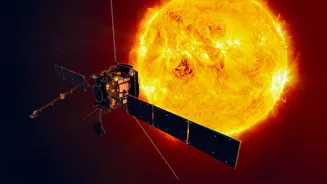
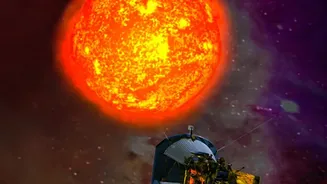
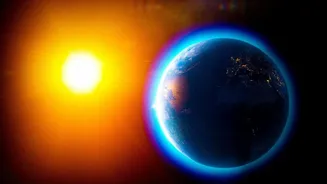
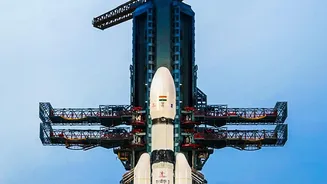
Launched by the Indian Space Research Organisation (ISRO) in September 2023, Aditya-L1 is India’s first dedicated solar observatory. It is strategically positioned at Lagrange Point 1 (L1), about 1.5 million kilometres from Earth, where it can maintain
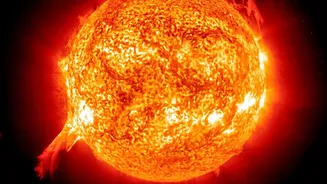
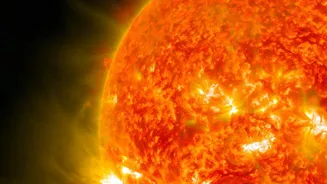
a continuous, uninterrupted view of the Sun. This vantage point is crucial, allowing it to escape the day-night cycle and eclipses that hinder ground-based observation. Aditya-L1 is equipped with seven sophisticated instruments designed to study everything from the Sun's outer layers—the photosphere, chromosphere, and corona—to the solar wind and magnetic fields that permeate space. A key payload, the Visible Emission Line Coronagraph (VELC), allows scientists to study the solar corona, the Sun’s superheated outer atmosphere, closer to the solar disk than was previously possible.
Europe's Innovative Artificial Eclipse
The European Space Agency's (ESA) Proba-3 mission, launched in December 2024 aboard an ISRO PSLV rocket, is a marvel of engineering. It is the world's first precision formation-flying mission, consisting of two separate spacecraft operating in perfect coordination. One spacecraft, the 'Occulter', flies about 150 metres in front of the other, the 'Coronagraph'. This precise alignment allows the Occulter to block the Sun's blindingly bright disk, creating a sustained artificial eclipse in space. This technique allows the Coronagraph's main instrument, ASPIICS, to capture stunningly clear images of the Sun’s faint inner corona, a region notoriously difficult to observe. While its primary goal is to demonstrate this advanced formation-flying technology, its scientific payoff is immense.
A Synergy Forged in Science
The collaboration between the Aditya-L1 and Proba-3 teams is more than just a happy coincidence; it is a deliberate scientific partnership. Scientists from ISRO and ESA have been working together, holding joint workshops to explore how to combine data from the two missions for a more comprehensive understanding of the Sun. This partnership has already borne fruit, with researchers from the Indian Institute of Astrophysics (IIA) and their European counterparts jointly analysing observations of the same solar events. In September 2025, both missions simultaneously recorded two Coronal Mass Ejections (CMEs)—massive eruptions of solar plasma. The joint study, published in the journal 'Astronomy & Astrophysics', provided unprecedented details about the mass, density, and energy of these eruptions right as they happened.
Why Two Views Are Better Than One
Observing the Sun with multiple spacecraft from different vantage points provides a more complete, three-dimensional picture of solar phenomena. The synergy between Aditya-L1 and Proba-3 is a perfect example. Proba-3's artificial eclipse provides an exceptionally clear view of the corona very close to the Sun's surface, while Aditya-L1's VELC instrument uses spectroscopy to measure the temperature and density of the coronal gas. In essence, Proba-3 provides the high-definition close-up, while Aditya-L1 provides the crucial diagnostic data. By combining imaging from Proba-3 and spectroscopic data from Aditya-L1, scientists can cross-check their findings and build a much more robust model of how CMEs are initiated and how they evolve. This is vital for improving our ability to forecast space weather, which can disrupt satellites, power grids, and communication systems on Earth.