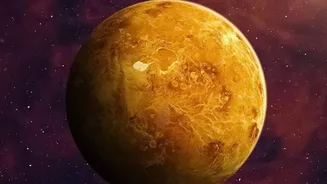




It sounds like a riddle, but it's a cosmic fact: on Venus, a day is longer than a year. This isn't a trick of language but a bizarre reality of our solar system, showcasing how alien other worlds can be compared to our own.
Defining Our Terms: Day vs. Year
Before diving into Venus's weird
timeline, let's clarify what 'day' and 'year' mean. For us on Earth, these concepts are straightforward. A year is the time it takes for our planet to complete one full orbit around the Sun, roughly 365 days. A day is the time it takes for the Earth to spin once on its axis, about 24 hours. This rotation is what gives us the cycle of day and night. The headline's claim hinges on these two distinct motions: the orbit around the Sun (a year) and the spin on an axis (a day).
Venus by the Numbers
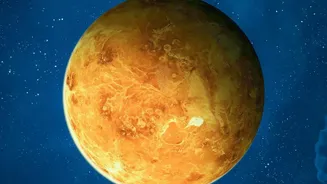
Now, let's apply these concepts to Venus. Our planetary neighbor completes its orbit around the Sun in about 225 Earth days. This is its year. However, Venus rotates on its axis incredibly slowly. One full rotation, known as a sidereal day, takes approximately 243 Earth days. So, the time it takes for Venus to spin once is longer than the time it takes for it to travel all the way around the Sun. It's a mind-bending reality: on Venus, a single day is longer than a full year.
A Planet That Spins Backwards
Adding to the strangeness is Venus's direction of rotation. Unlike Earth and most other planets in the solar system, Venus spins clockwise, a phenomenon known as retrograde rotation. This means if you could stand on the surface of Venus, you would see the Sun rise in the west and set in the east. This backward spin has a curious effect on the length of a 'solar day'—the time from one sunrise to the next. Because the planet is rotating backwards as it moves forward in its orbit, a solar day on Venus is about 117 Earth days long. While this is shorter than its 243-day rotation period, it still means a morning on Venus lasts nearly two Earth months.
Why the Slow, Backward Spin?
Scientists don't have a single definitive answer for Venus's peculiar rotation, but there are two leading theories. The first is the 'giant impact' theory. This idea suggests that early in the solar system's history, a massive planet-sized object collided with Venus, sending it spinning in the opposite direction or even flipping it almost completely upside down. The second major theory involves Venus's incredibly thick atmosphere. Its atmosphere is about 90 times more massive than Earth's and experiences powerful winds that whip around the planet much faster than it rotates. Some models suggest that the combination of the Sun's powerful gravitational pull and the friction from this heavy, circulating atmosphere could have slowed Venus's rotation over billions of years and eventually reversed it. This balance between solar gravity and atmospheric tides may be what holds Venus in its current, strange state.
A Truly Alien Environment
This bizarre timekeeping is just one aspect of Venus's extreme nature. The planet's surface is one of the most hostile environments imaginable. Its thick carbon dioxide atmosphere has created a runaway greenhouse effect, trapping heat and sending surface temperatures to an average of 465°C (869°F), hot enough to melt lead. The atmospheric pressure at the surface is over 90 times that of Earth at sea level, equivalent to being nearly a kilometer deep in the ocean. Together, these conditions paint a picture of a world utterly unlike our own, where even the fundamental rhythm of day and year is turned on its head.