



The Classic Story of the Moon's Birth
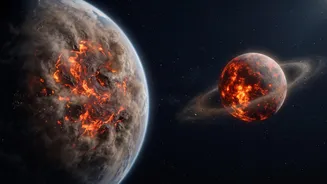
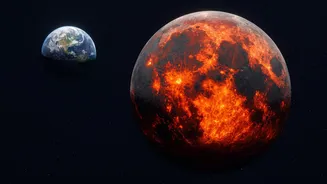
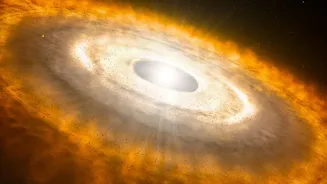
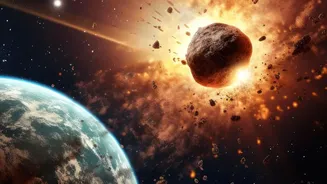
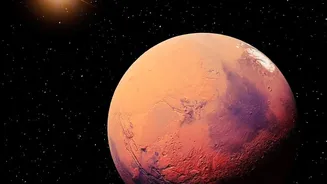
For years, the leading scientific theory for the Moon's origin has been the 'giant-impact hypothesis'. This story begins about 4.5 billion years ago, when the solar system was a chaotic, crowded place. It proposes that a Mars-sized protoplanet, nicknamed
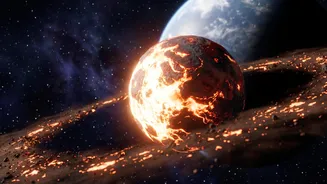
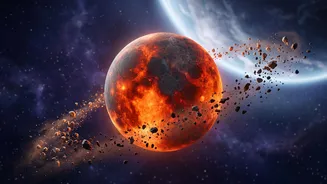
Theia, slammed into a very young Earth. The collision was so immense it would have vaporised Theia and thrown a colossal amount of molten rock and debris into orbit around our planet. According to this classic model, this ring of super-heated debris then slowly, over thousands of years, coalesced under gravity to form the Moon we see today. This theory explained many things, but it also left some nagging puzzles for scientists to solve.
A New, Faster Timeline Emerges
Recent studies, using powerful supercomputer simulations, are now challenging that classic, slow-burn narrative. Researchers at institutions like NASA and Durham University ran hundreds of highly detailed simulations of the Earth-Theia impact, but with a new twist. They adjusted variables like the temperature and geologic strength of the colliding worlds, factors previously considered less important. The results were stunning. In some scenarios, particularly when the colliding bodies were hotter and therefore weaker, the impact didn't create a long-lasting debris disk at all. Instead, the cataclysmic collision launched a massive, largely intact body directly into a stable orbit around Earth. This proto-Moon assembled itself not over millennia, but in as little as five hours.
Solving the Cosmic 'Isotope Crisis'
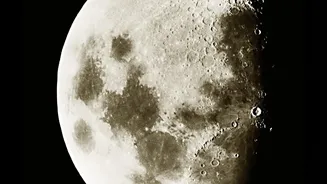
One of the biggest problems with the old theory was the Moon's composition. Rock samples brought back by Apollo astronauts showed that the Moon has a chemical signature remarkably similar to Earth's. If the Moon formed mostly from the debris of Theia, as the classic model suggested, it should look very different. This discrepancy is known as the 'isotope crisis'. The new, rapid-formation theory offers a more elegant solution. A more violent and immediate creation would have resulted in a thorough mixing of material from both Earth and Theia. Some simulations show that the outer layers of the resulting Moon would be made of more Earth-derived material, which could neatly explain why the lunar rocks we've analysed look so much like home.
Explaining the Moon's Peculiar Orbit
Beyond its composition, the Moon has other strange characteristics. Its orbit is tilted relative to Earth, and its crust is surprisingly thin. The slow, debris-disk model struggled to account for these features without adding extra steps and complexity. The single-stage, rapid-formation scenario, however, can potentially explain them much more cleanly. Launching a nearly-complete satellite directly into a wide, stable orbit avoids some of the messy physics that would have governed a slowly forming body close to Earth. A proto-Moon that isn't fully molten could also better explain its current internal structure and thin crust, making the fast-birth theory an enticing all-in-one explanation for several lunar mysteries.
What This Means for Future Missions
This isn't just an academic debate; it has practical implications for future lunar exploration. Understanding the Moon's origin story helps us understand the evolution of Earth itself. The histories of the two bodies are intertwined, and learning about the Moon's formation can reveal secrets about our own planet's path to becoming a life-harboring world. Future missions, like those under the Artemis program, will involve collecting new lunar samples from different regions of the Moon. Analysing these samples will be crucial. Scientists can look for specific geological clues that would either support the rapid-formation model or the older debris-disk theory. Pinning down how the Moon was made will help us reconstruct the violent, chaotic history of our entire solar system.