

Earth’s Ever-Shifting Surface
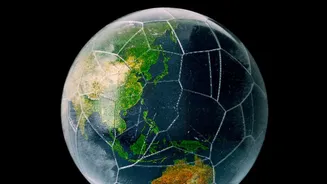
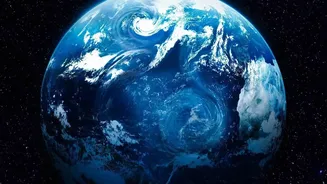
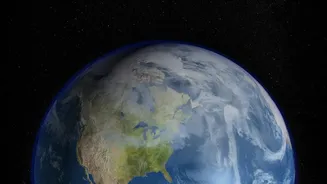
The story of our planet is one of perpetual movement. The Earth’s outer shell is broken into massive pieces called tectonic plates, which float on the semi-molten mantle beneath them. This movement is incredibly slow, often just a few centimetres per year,
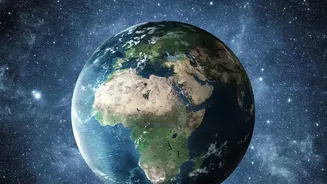
about the same speed your fingernails grow. Over millions of years, this glacial pace is powerful enough to rearrange the entire map of the world. This process drove the breakup of the most famous supercontinent, Pangaea, which began to split apart around 200 million years ago, eventually giving us the seven continents and the oceans we know today. But this breakup wasn't the end of the story; it was just one phase in an ongoing cycle.
The Great Supercontinent Cycle
Geologists believe Earth has been assembling and breaking apart supercontinents for at least two billion years in what is known as the supercontinent cycle. This cycle, with a rough period of 400 to 600 million years, has seen the birth and death of landmasses like Rodinia, Columbia, and Pannotia long before Pangaea came to be. We are currently in the middle of a cycle, with continents scattered across the globe. Naturally, scientists wonder what comes next. By using supercomputers to model the long-term motion of tectonic plates, they can create data-driven forecasts of what our planet might look like hundreds of millions of years from now. One of the most compelling predictions is the formation of a future supercontinent named Amasia.
Meet Amasia, a Glimpse of the Future
The leading theory for our planet's next great merger is Amasia, a portmanteau of America and Asia. The concept, supported by recent supercomputer simulations from researchers at Curtin University, suggests that in 200 to 300 million years, the Americas will drift west and collide with a northward-moving Australia and a relatively stationary Asia, closing the Pacific Ocean in the process. This model predicts the new landmass would be clustered around the Northern Hemisphere. This would create a world dramatically different from our own, with one vast supercontinent dominating the planet and a much larger Atlantic Ocean.
Why the Pacific Is Doomed
The formation of Amasia hinges on a process called "extroversion." This is when a supercontinent forms by closing the older, exterior ocean that surrounded the previous one—in this case, the Pacific. The Pacific Ocean is a remnant of the vast Panthalassa superocean that encircled Pangaea. It is Earth's oldest ocean, and it's already shrinking, losing a few centimetres each year. This is happening because its floor is being pulled under the surrounding continental plates in subduction zones, like the famous "Ring of Fire." The deepest parts of the ocean, like the Mariana Trench, are found in these exact zones, marking the seams where the Pacific is slowly being consumed. Scientific models suggest that as Earth has cooled over billions of years, its oceanic plates have become weaker, making it easier to close an old ocean like the Pacific than a younger one like the Atlantic.
Other Paths for Earth's Future
Amasia is a strong candidate, but it's not the only possibility on the geological drawing board. Another model, called "Pangaea Proxima" (or Pangaea Ultima), suggests the opposite could happen. In this "introversion" scenario, the younger Atlantic and Indian Oceans would close, pulling the continents back together into a shape vaguely resembling the original Pangaea. Other theories include Aurica, where a new ocean basin splits Asia and the continents converge near the equator, and Novopangaea. Each model depends on complex variables and which oceans end up closing. The future is not set in stone, but the Amasia model has gained significant traction based on recent simulations of how tectonic plates behave on a cooling planet.
A Different World Entirely
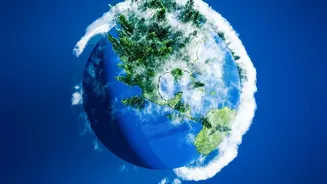
Regardless of how it forms, the next supercontinent would create an environment alien to our own. With most land fused together, vast inland deserts would emerge, far from the moderating influence of the ocean. Sea levels would likely be lower. In the Amasia scenario, a landmass gathered around the North Pole could disrupt the ocean currents that transport heat from the equator, potentially leading to a much colder planet with massive ice caps. In contrast, a supercontinent like Aurica clustered at the equator could create a much hotter world. These are not just geographic curiosities; they are projections of a planetary-scale transformation that would dictate the course of climate and evolution for eons to come.