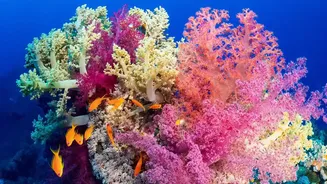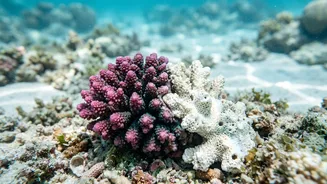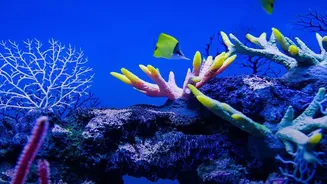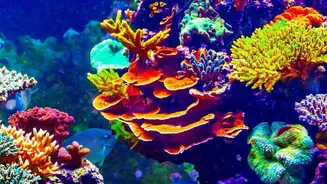






Amid dire warnings about the future of the world's coral reefs, a surprising discovery offers a glimmer of hope. A small study has found that simply touching a healthy coral fragment can bring a bleached, dying one back to life with stunning speed.
A Global Crisis in Our Oceans
Coral
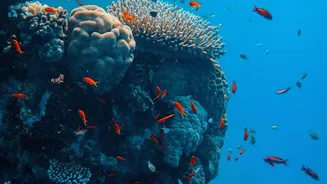
reefs, often called the 'rainforests of the sea', are in grave danger. From the Great Barrier Reef to the vibrant ecosystems in India’s own Andaman and Nicobar Islands, rising ocean temperatures are causing mass bleaching events. This happens when stressed corals expel the symbiotic algae living in their tissues, which provide them with both food and their brilliant colours. Without these algae, the corals turn a ghostly white, begin to starve, and often die, threatening the one-third of all marine species that depend on them. While recovery is possible, it can take months or even years, a timeline often too slow to keep up with recurring marine heatwaves.
An Accidental Breakthrough
The new finding came about by accident. In a lab at Stanford University, researchers noticed that a healthy coral fragment had tipped over in its tank and was touching a bleached piece from the same original colony. To their astonishment, where the two made contact, colour began to return to the bleached coral, signalling a recovery far faster than expected. This serendipitous observation prompted a formal study, led by Ph.D. student Danny Collins, to investigate if this 'healing touch' could be a reliable way to save dying corals. The question was simple but profound: once a coral has bleached, what can we do to help it?
The Striking Power of Fusion
The results of the lab experiments were remarkable. The study, published in Science Advances, found that when a bleached coral fragment was placed in direct contact with a healthy, genetically identical one, it could fully recover in as little as seven weeks. This is the fastest documented recovery from coral bleaching to date. Researchers discovered that the two pieces of coral fuse their tissues, creating microscopic channels that act like a 'nutrient highway'. Through this bridge, the healthy coral transfers life-giving algae and nutrients to its bleached partner, kickstarting the recovery process. Even a brief contact period of just five to seven days was sometimes enough to provide the bleached fragment with what it needed to heal on its own.
A New Hope for Restoration
The speed of this recovery is what makes the finding so significant. The algae populations in the recovering fragments were observed doubling every four days, a rate roughly ten times faster than what is typically seen in the wild. This suggests a powerful, natural recovery mechanism that was previously unknown. While traditional restoration efforts often involve growing coral fragments separately in nurseries—a slow and laborious process—this technique of 'autofusion' could potentially accelerate efforts dramatically. It opens the door for new restoration strategies, where healthy corals could be used as 'donors' to resuscitate bleached sections of a reef. This research provides a critical foundation for developing new interventions that could one day be deployed in the field.
Cautious Optimism and Next Steps
Despite the excitement, researchers are cautious. The study was conducted on a small scale in a controlled lab environment. A major limitation is that the healing touch only works between genetically identical corals, or clones from the same parent colony. When fragments from different genetic parents touch, they often trigger a hostile reaction instead of fusing. This makes the direct application on a massive, genetically diverse reef impractical for now. The next challenge for scientists is to figure out how to scale this concept. Researchers are exploring ways to extract the beneficial algae from healthy corals and deliver them to bleached reefs in large batches, potentially providing a scalable solution based on this initial breakthrough.