



Listening to a Quiet Planet
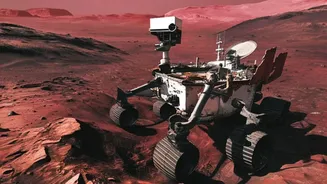
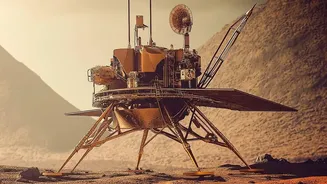
Before its mission ended in late 2022, the InSight lander placed an ultra-sensitive seismometer on the Martian surface to listen for “marsquakes.”. For four years, it recorded the faint tremors that vibrated through the planet's interior.. Much like how
an ultrasound uses sound waves to create an image of what's inside a body, scientists can use the seismic waves from these quakes to map the hidden geology of Mars.. By studying how the speed and shape of these waves change as they travel, researchers can deduce the properties of the rock they pass through, including its density, porosity, and whether it might contain water.
An Unexpected Signal From Below
Initial analysis of InSight's data had already provided a revolutionary look at the Martian interior, confirming its molten core and measuring its crust and mantle for the first time.. But a more recent, deeper dive into the seismic records has yielded an even more tantalizing possibility. A team of geophysicists, led by Vashan Wright at Scripps Institution of Oceanography, noticed something unusual about the way seismic waves behaved in a layer between 11 and 20 kilometers deep.. The data from this zone simply didn't match models of dry rock. The best explanation, according to their analysis, was a crust made of fractured igneous rock with its pores and cracks saturated with liquid water.
Not Rivers, but a Planetary Sponge
This isn't a 'plumbing system' of underground rivers or caves. Instead, scientists theorize it could be a vast, planet-wide network of porous rock acting like a sponge, holding an immense amount of briny water.. The pressure deep in the crust could be high enough to keep this water liquid, despite Mars’ frigid surface temperatures.. This theory helps solve a long-standing mystery: where did all of Mars’ ancient water go? For decades, scientists have seen evidence of past oceans and rivers, but the planet today is a desert.. While some water is locked as ice at the poles and some was lost to space, this new finding suggests a huge volume may have retreated deep underground, becoming part of the planet's internal structure.
The Search for Life Goes Deeper
The implications for the search for life are profound. On Earth, wherever we find liquid water, we find life. While the conditions deep within the Martian crust would be harsh—dark, cold, and under immense pressure—the mere presence of liquid water dramatically increases the chances that Mars could harbor microbial life, or at least preserve evidence of it from a more temperate past.. This potential subsurface water-world is a far cry from the static, dead planet scientists once imagined.. The discovery suggests Mars might have a more complex and active interior than previously thought, possibly involving ancient magmatic systems that helped shape this environment.. These deep, water-saturated zones now represent one of the most compelling targets for future exploration and the ongoing search for extraterrestrial life.