




A New Eye on the Cosmos
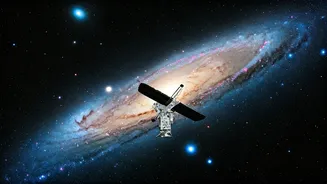
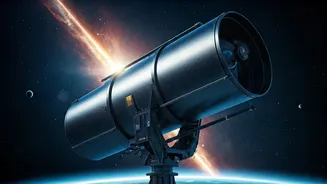
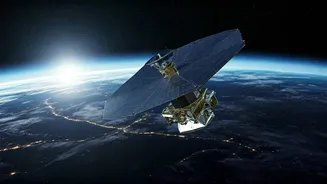
Meet the Nancy Grace Roman Space Telescope, the spiritual successor and powerful complement to observatories like the Hubble and James Webb. Named after NASA’s first chief of astronomy, the so-called “mother of Hubble,” this mission is designed to tackle
some of the biggest questions in cosmology. While Hubble gave us narrow, deep glimpses into the ancient universe, Roman is built for breadth. It’s a survey telescope, designed to map vast stretches of the sky with incredible speed and detail. It has the same mirror size as Hubble but boasts a field of view at least 100 times larger. Imagine being able to see an entire mural in one glance, instead of peering at it through a keyhole; that’s the leap Roman represents. In the time it took Hubble to photograph its iconic Ultra-Deep Field and reveal a few thousand galaxies, Roman could capture millions.
The Million-Mile Journey
Roman is traveling to a very special place in space: the second Lagrange point, or L2. This is a spot 1.5 million kilometers (nearly a million miles) from Earth, directly away from the Sun. Think of it as a gravitational parking spot. At L2, the gravitational pull of the Sun and Earth balance out in a way that allows the telescope to stay in a stable position relative to us. This location is a favorite for space telescopes like the James Webb for a few key reasons. It provides a clear, unobstructed view of the cosmos, away from the glare and heat of Earth and the Moon. This thermal stability is crucial for its sensitive infrared detectors, which need to stay incredibly cold to see the faint light from the distant universe.
Chasing Cosmic Ghosts
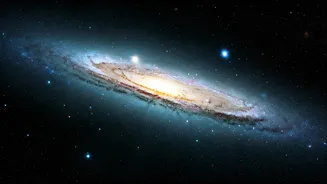
Roman’s primary mission is to confront two of the universe's greatest invisibles: dark energy and dark matter. Scientists believe dark energy is the mysterious force causing the expansion of the universe to accelerate, but they don’t know what it is. Roman will address this by creating a colossal 3D map of the universe, measuring the light from billions of galaxies and thousands of supernovae. By precisely measuring their distances and how they are distributed, scientists can trace the history of cosmic expansion and learn about the nature of the dark energy driving it. Its panoramic view is essential for this task, allowing it to gather the massive statistical sample needed to detect the subtle effects of these cosmic phantoms over billions of years.
Finding Thousands of New Worlds
Beyond its cosmological quest, Roman is also a revolutionary planet-hunting machine. It will primarily use a clever technique called gravitational microlensing to find new exoplanets. This method, predicted by Einstein, uses the gravity of a foreground star as a natural magnifying glass. When a planet passes in front of that star, it creates a brief, tell-tale spike in the brightness of a more distant background star. Because this technique is sensitive to the planet's mass, not its light, Roman can find worlds much farther away and of different types than ever before, including rogue planets that drift through space untethered to a star. Scientists expect Roman to discover thousands of new worlds this way, creating a census of planets in our galaxy.
A Testbed for Future Discoveries
Tucked inside Roman is another groundbreaking piece of hardware: the Coronagraph Instrument. This is a technology demonstration designed to do something incredibly difficult—directly image planets orbiting other stars. Coronagraphs work by blocking the overwhelming glare of a star, allowing the faint, reflected light from an orbiting planet to be seen. Roman's coronagraph is the most powerful one ever sent to space, with self-flexing mirrors that actively correct for tiny distortions to create a super-sharp image. It is designed to be 100 to 1,000 times better at suppressing starlight than previous instruments. While it will focus on large, Jupiter-like planets, the technology it proves will be a crucial stepping stone for future missions that aim to take pictures of Earth-like worlds.