






An Unprecedented Journey Into the Void
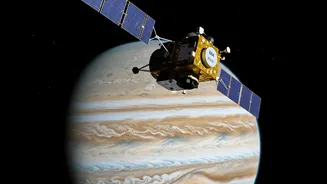
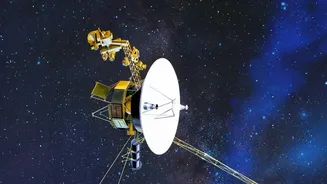
Launched in 1977, the twin Voyager 1 and Voyager 2 spacecraft completed a 'Grand Tour' of our solar system's outer planets, revolutionizing our understanding of Jupiter, Saturn, Uranus, and Neptune. But their mission didn't end there. They kept going,
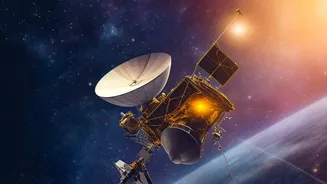
hurtling towards the space between the stars. In 2012, Voyager 1 became the first human-made object to enter interstellar space, with Voyager 2 following in 2018. They are now humanity's only direct observers in this uncharted territory, sending back invaluable data from billions of kilometres away. These probes represent one of the greatest feats of exploration in human history, acting as our remote eyes and ears in the cosmic ocean. Their continued operation is a testament to the engineers who built them and the teams that have managed their epic journey for decades.
The Inevitable Decline of Power
The Voyager probes are not solar-powered; they are far too distant from the Sun for that. Instead, they rely on radioisotope thermoelectric generators, or RTGs, which convert the heat from decaying plutonium into electricity. When they launched, these power sources provided ample energy. But the radioactive decay that produces the heat also means the power supply inevitably dwindles. Every year, the probes lose about four watts of electrical power. For a mission operating on the thinnest of margins, this steady decline is a constant threat. To conserve energy, NASA's engineers at the Jet Propulsion Laboratory have been forced to make difficult choices over the years, systematically turning off instrument heaters and, eventually, the scientific instruments themselves. This slow-motion shutdown threatened to end the Voyagers' scientific mission entirely.
A 'Big Bang' at the Edge of the Solar System
Faced with shutting down another key science instrument on Voyager 2, the mission team devised a daring plan. Nicknamed the 'Big Bang' maneuver, the solution is a clever feat of remote engineering. Instead of simply turning things off, engineers found a way to use a small reserve of backup power that was originally set aside for a safety mechanism on the spacecraft. By tapping into this reserve, they could redistribute power across the probe's systems. This allowed them to turn off certain non-essential components while still keeping the spacecraft warm enough to function in the frigid environment of deep space. The delicate operation, successfully performed on Voyager 2 in mid-2026, was a calculated risk. The result, however, was a significant gain in the power budget—enough to keep all of the probe's remaining instruments running for at least another year.
The Data Worth Saving
The science at stake is nothing less than our first direct taste of the galaxy beyond our solar bubble. The probes are measuring the interstellar medium (ISM), the sparse collection of plasma, gas, dust, and cosmic rays that fills the vast spaces between stars. For centuries, our understanding of the ISM was based on distant observations. The Voyagers are physically there, sampling this environment directly. They measure the density of particles, the strength and direction of magnetic fields, and the waves rippling through the interstellar plasma. This data provides crucial insights into how our solar system, cocooned in a protective bubble called the heliosphere, interacts with its galactic neighborhood. It helps scientists understand the lifecycle of stars, the structure of our galaxy, and the very nature of the space we will one day hope to travel through.
What This Extra Year Buys Humanity
The success of the 'Big Bang' maneuver on Voyager 2 is more than just a technical victory; it is a significant gain for science. It means that instruments measuring interstellar plasma and magnetic fields will continue to operate, providing a continuous stream of data from a region no other probe has reached. Now, engineers are planning to implement the same power-saving hack on Voyager 1, which is even farther from Earth and in a more precarious power situation. In fact, an important instrument on Voyager 1, the Low-Energy Charged Particle experiment, had to be shut down earlier this year to save power. This new technique offers hope that the mission can be prolonged further, preserving our only direct line of communication from interstellar space and deepening a scientific legacy that has already lasted a lifetime.