







An Icon on Borrowed Time
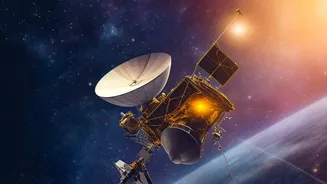
Launched in 1977, Voyager 2 is a legend of space exploration. It's the only spacecraft to have visited the ice giants Uranus and Neptune, and in 2018 it joined its twin, Voyager 1, as the only human-made objects to enter interstellar space. But after
almost 49 years and more than 21 billion kilometers, the probe is facing a fundamental problem: its power is running out. Voyager 2 isn’t powered by solar panels; it's far too distant from the sun for that. Instead, it relies on three radioisotope thermoelectric generators (RTGs), which convert heat from decaying plutonium into electricity. This power source has been incredibly reliable, but the plutonium's decay means the spacecraft loses about four watts of power every year. With margins razor-thin, NASA engineers have been forced to make tough decisions, shutting down instruments to conserve every last bit of energy.
The 'Big Bang' Solution
To prevent the shutdown of yet another critical science instrument before the end of 2026, engineers at NASA's Jet Propulsion Laboratory (JPL) devised an ingenious fix nicknamed the 'Big Bang'. The plan involved a carefully coordinated swap: turning off certain powered devices and substituting them with lower-power alternatives, all while ensuring the spacecraft remains warm enough to function in the freezing void of interstellar space. One of the key parts of the maneuver involved no longer relying on certain heaters and even a long-dormant digital tape recorder that was kept on partly because its operation generated a small amount of useful heat. By redistributing this power, engineers successfully freed up enough energy to keep the remaining science instruments running for longer than anticipated, a remarkable feat of remote engineering on a nearly 50-year-old machine.
The Irreplaceable Science at Stake
This power-saving maneuver was all about protecting Voyager 2’s most valuable remaining scientific function: directly sampling the environment between the stars. The three instruments saved by this effort are the Cosmic Ray Subsystem, the Magnetometer, and the Plasma Wave Subsystem. Together, they provide unprecedented data on the true nature of interstellar space. The cosmic ray instrument measures high-energy particles that originate from events like supernovae, while the magnetometer measures the direction and strength of the magnetic fields that permeate the galaxy. The plasma wave instrument 'listens' to the hum of plasma—the ionized gas that makes up the interstellar medium—allowing scientists to measure its density directly. This is data we can't get from within our solar system's protective bubble, the heliosphere. Voyager 2 is our first-hand reporter from this unexplored territory.
A Legacy of Discovery Extended
The successful power shuffle is expected to extend the operational life of Voyager 2's science trio by at least an additional year, possibly more. This is a huge victory for a mission that was originally planned to last just five years. The maneuver is so successful that the mission team plans to perform a similar power swap on Voyager 1 in the coming months. Each day these probes continue to function provides invaluable information, challenging and refining our models of the galaxy. They have revealed that the interstellar medium is more complex and dynamic than previously thought, a turbulent frontier just beyond our cosmic doorstep. The data helps scientists understand the boundary where our sun's influence ends and the vast Milky Way truly begins.