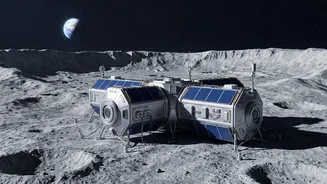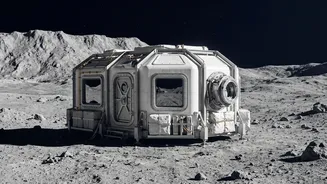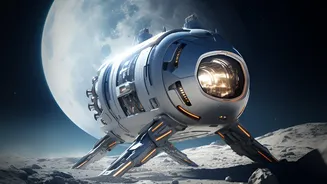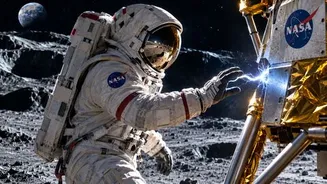

NASA is calling on the next generation of innovators to help design a future lunar outpost. For Indian students with a passion for space, this isn't just a distant dream—it's a real opportunity to contribute to humanity's return to the Moon.
Your Chance to Design a Moon Base
NASA has launched
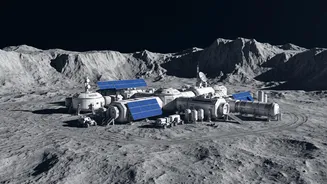
the '$1 Million Moon Base Student Challenge', a competition that invites students to tackle the complex problems of living and working on the Moon. Announced in early November 2026, the contest asks teams to develop innovative concepts for a sustained human presence at the lunar South Pole. This initiative is not just an academic exercise; it is directly linked to NASA's Artemis program, which aims to establish a long-term base on the Moon. Student ideas will contribute to the body of work that could one day become a reality, supporting astronauts as they conduct research and prepare for future missions to Mars. Teams can choose to focus on one of six critical areas: power generation, habitat construction, life-support systems, surface mobility, communication networks, or astronaut safety.
Who Is Eligible to Participate?
The headline's mention of 'US Student Teams' might seem limiting, but the details offer a promising opening for international talent. The competition is open to teams from eligible high schools and post-secondary institutions based in the United States. Crucially, the rules explicitly state that foreign citizens can participate, provided they are full-time students at an eligible U.S. institution and reside in the U.S. during the competition. This means that the thousands of Indian students currently enrolled in American high schools, colleges, and universities are eligible to form or join a team. Teams consist of two to five students and must be supported by an adult coach from their institution. The deadline to register via the NASA STEM Gateway is January 25, 2027, with initial concept papers due by February 22, 2027.
What Does the Challenge Involve?
This isn't a contest about building physical prototypes. Instead, it focuses on innovation at the conceptual level. The initial submission is a five- to seven-page paper outlining the team's design. The proposal must detail how the solution would function in the harsh lunar environment, which includes extreme temperatures, a vacuum, abrasive dust, and high radiation. NASA emphasizes that prior specialized engineering experience is not a requirement. The agency is looking for creativity, critical thinking, and a willingness to tackle difficult problems. Finalist teams will receive funding to further develop their concepts and will eventually present their ideas in a technical paper and a pitch video to a panel of NASA and industry experts. The total prize pool is up to $1 million, with grand prizes available for the top teams.
Opportunities for Students in India
For students in India, the ambition to contribute to space exploration doesn't have to wait for an opportunity abroad. The Indian Space Research Organisation (ISRO) is actively expanding its own programs to involve young innovators. Initiatives like the ISRO Robotics Challenge (IRoC-U) and competitions organised by the Indian National Space Promotion and Authorisation Centre (IN-SPACe) give students handson experience. These events challenge participants to design everything from smallscale satellites, known as CanSats, to model rockets. ISRO also provides mentorship from its scientists and financial support through its RESPOND programme for universityled research in space science. Furthermore, several Space Technology Incubation Centres have been set up across the country to foster collaboration between universities and ISRO, helping students develop indigenous space technologies.
The Future is Collaborative
Challenges like these underscore a global trend: the future of space exploration is collaborative and requires diverse talent. Whether it's an Indian student at a U.S. university designing a lunar habitat for NASA or a team from a Tier‑2 city in India launching a satellite through an ISRO program, the doors to the space industry are opening wider than ever. These competitions are more than just a chance to win a prize; they are a launchpad for careers. They provide practical, career‑relevant skills and connect students with a network of experts and potential employers in the growing aerospace sector. As humanity sets its sights on becoming a multi‑planetary species, the ideas and passion of today's students will be what ultimately gets us there.