


The Physics of the Cosmic Dance
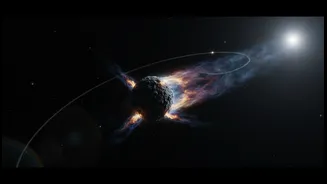
At its core, predicting an asteroid's path is an exercise in fundamental physics that would be familiar to Isaac Newton. The solar system is a grand cosmic dance governed by gravity. Astronomers begin by taking at least three distinct observations of
a moving point of light against the backdrop of fixed stars. From these initial data points, they can calculate a preliminary orbit around the Sun. This orbit is an ellipse, defined by a set of numbers, or elements, that describe its shape, size, and orientation in space. Once this orbit is known, scientists can, in theory, project where the asteroid will be at any point in the future. This process is managed by international bodies like the Minor Planet Center, which serves as a global archive for all small-body observations from telescopes around the world.
The Challenge of Imperfect Information
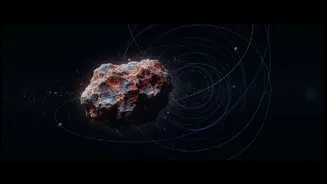
However, reality is far messier than a simple calculation. Initial observations are never perfect and always contain small errors. This initial uncertainty means that instead of a single, precise orbital path, scientists are left with a cloud of possible orbits. As more observations are made over time—from optical telescopes and radar—the uncertainty shrinks, and the orbital prediction becomes more refined. But other, more subtle forces are also at play. The gravitational pull of planets can slightly alter an asteroid's course. More complex is the Yarkovsky effect, a tiny but persistent push caused by the way an asteroid absorbs sunlight and radiates it back into space as heat. This force, while minuscule, can significantly alter an asteroid's path over decades or centuries, making it a critical factor in long-term predictions.
Embracing Uncertainty with Sentry-II
This is where error management becomes the star of the show. NASA's Planetary Defense Coordination Office (PDCO) leads this effort, using sophisticated systems to turn uncertain data into a reliable risk assessment. The primary tool for this is a powerful algorithm called Sentry-II. Operational since late 2021, Sentry-II takes the cloud of possible orbits for tens of thousands of known near-Earth asteroids and runs countless simulations to see which, if any, could result in an impact with Earth. Unlike its predecessor, Sentry-II is designed to be more robust, capable of identifying even extremely low-probability impact scenarios that might have been missed before. It searches for potential impacts over the next century, providing a constantly updated list of objects that require closer monitoring.
From Probability to a Plan
The output from Sentry-II isn't a simple yes or no, but a probability. To help experts prioritise these risks, they use tools like the Palermo Technical Impact Hazard Scale. This logarithmic scale combines the impact probability, the time until the potential impact, and the estimated kinetic energy of the object into a single value. A negative value generally indicates no cause for concern, while values between -2 and 0 suggest the object warrants careful monitoring. A positive value would signify a more serious situation that demands attention. This system allows organizations like the PDCO to focus their resources on tracking the objects that matter most and to coordinate with international partners for follow-up observations. To date, no known asteroid has a significant chance of hitting Earth in the next 100 years.