

What is Vehicle-to-Vehicle (V2V) Communication?
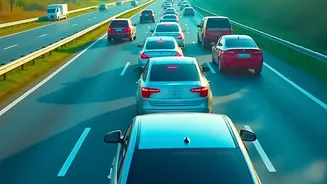
Imagine your car is driving down a highway. Three cars ahead, a driver slams on the brakes. You can't see it, and neither can your car's cameras or radar. But what if your car already knew? That is the core promise of V2V communication. It’s a technology
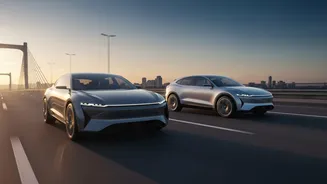
that allows vehicles to wirelessly broadcast and receive real-time information—like their speed, position, direction, and braking status—to and from other V2V-equipped vehicles within a range of about 300 metres. This system allows cars to “see” around corners and “through” other traffic, creating a 360-degree awareness that goes far beyond the driver's line of sight. It's part of a broader ecosystem called Vehicle-to-Everything (V2X), which also includes communication with infrastructure (V2I), pedestrians (V2P), and networks (V2N).
A Lifesaving Mandate for Indian Roads
India has one of the highest rates of road accident fatalities in the world. To tackle this, the Ministry of Road Transport and Highways (MoRTH) has issued a draft notification proposing a phased mandate for V2V systems. From October 1, 2028, all newly manufactured two-wheelers, passenger cars, and commercial vehicles (Categories L, M, and N) would be required to have V2V systems compliant with India’s new AIS-230 standard. The technology is based on Cellular V2X (C-V2X), which leverages mobile networks to function. The key application is the Emergency Electronic Brake Light (EEBL) warning. When a vehicle brakes suddenly, it can instantly alert following vehicles, giving drivers precious extra seconds to react and potentially preventing deadly pile-ups on highways and blind curves.
The Millisecond Problem: Latency and Network
For a sudden-braking alert to be effective, it must be virtually instantaneous. The time it takes for data to travel from one car to another—known as latency—is the single biggest technical hurdle. While 5G networks promise ultra-low latency of just a few milliseconds, real-world performance can vary. Studies have shown that while cellular network reliability can be high, actual latency in urban driving can be much higher than theoretical minimums, sometimes exceeding the threshold for real-time safety applications. A vehicle’s response with 5G can be significantly faster than a human's, but this relies on a consistent, high-quality network connection that may not be uniformly available across all of India's diverse and sometimes congested road networks. Any lag could render the warning useless.
The Hurdles of Scale and Cost
Beyond the technical challenge of latency, several practical roadblocks stand in the way. For V2V to work, a critical mass of vehicles must have the technology; if only one car on the road has it, it has nothing to communicate with. Given the vast number of older vehicles on Indian roads, achieving this density will take many years. Another major issue is cost. The onboard units required for V2V communication are estimated to cost between ₹5,000 and ₹7,000 per vehicle. While this may be a small percentage of a new car's price, it represents a significant additional cost for the more price-sensitive two-wheeler market, which is also included in the mandate. Finally, there is the challenge of interoperability and security. All vehicles, regardless of the manufacturer, must speak the same digital language to avoid miscommunication, and the entire system must be secured against cyberattacks that could cause fake alerts or system failures.
The Road Ahead: A Phased Reality
The government's push for V2V, starting with the delicensing of the 5.9 GHz spectrum band in June 2026, signals a clear intent. The phased rollout, starting with voluntary compliance in 2027 before the 2028 mandate, gives manufacturers time to adapt. Experts believe commercial vehicles may be the first to widely adopt the technology, as the return on investment for fleet safety is more clear-cut. The V2V initiative is part of a broader shift in India towards active safety systems, complementing the recent mandates for Advanced Driver Assistance Systems (ADAS) in heavy vehicles. While V2V is a powerful tool, it is not a silver bullet. It will likely coexist with and enhance existing camera- and radar-based safety systems for the foreseeable future.