




A Sweet Discovery in the Void
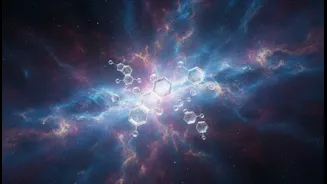
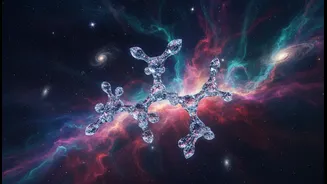
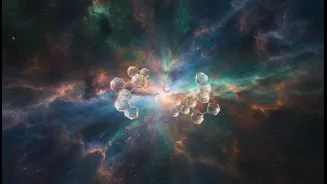
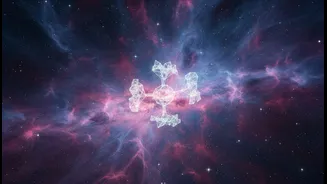
An international team of astronomers has detected a sugar molecule called erythrulose floating in a vast cloud of gas and dust near the centre of our Milky Way galaxy. Using powerful radio telescopes in Spain, scientists identified the unique radio frequency
signature of this specific four-carbon sugar in a molecular cloud known as G+0.693-0.027, located approximately 27,000 light-years from Earth. This marks the first time a 'true sugar' has been found in interstellar space. While simpler, related molecules had been found before, this discovery confirms that more complex organic compounds, fundamental to biology, can exist in the harsh, cold environment between stars. Interestingly, on Earth, erythrulose is a compound found naturally in raspberries and is also used in many sunless tanning lotions.
What Is the Cosmic Seeding Hypothesis?
This discovery breathes new life into a century-old theory known as 'panspermia', or the cosmic seeding hypothesis. In its most basic form, panspermia suggests that life on Earth may not have started here from scratch. Instead, it proposes that the essential building blocks of life—or even primitive life forms themselves—were formed elsewhere in the universe and delivered to our planet billions of years ago. This cosmic delivery service would have been carried out by meteorites, comets, and asteroids colliding with a young Earth. Scientists have long theorized that the conditions on early Earth might not have been sufficient to produce the complex molecules needed for life in high enough concentrations. The idea of panspermia provides an alternative source, suggesting that the universe itself is a vast chemical laboratory, creating these ingredients and scattering them across the cosmos like seeds.
Why This Particular Sugar Matters
Erythrulose is more than just a sweet molecule; it's a significant prebiotic chemical. Sugars are the fuel for cells and, crucially, form the structural backbone of our genetic material, DNA and RNA. While erythrulose itself is not a direct component of RNA or DNA, it belongs to the same family of molecules and is considered a key stepping stone. Its presence suggests that the processes to create even more complex and biologically vital sugars, like ribose (a component of RNA), can occur in space. The discovery was also surprising because erythrulose was found to be at least eight times more abundant than similar, but simpler, three-carbon sugars that scientists were also looking for. This implies that the chemical pathways for forming these crucial molecules in space might be different and more efficient than previously understood, potentially favouring the creation of larger sugars.
Connecting the Cosmic Dots to Earth
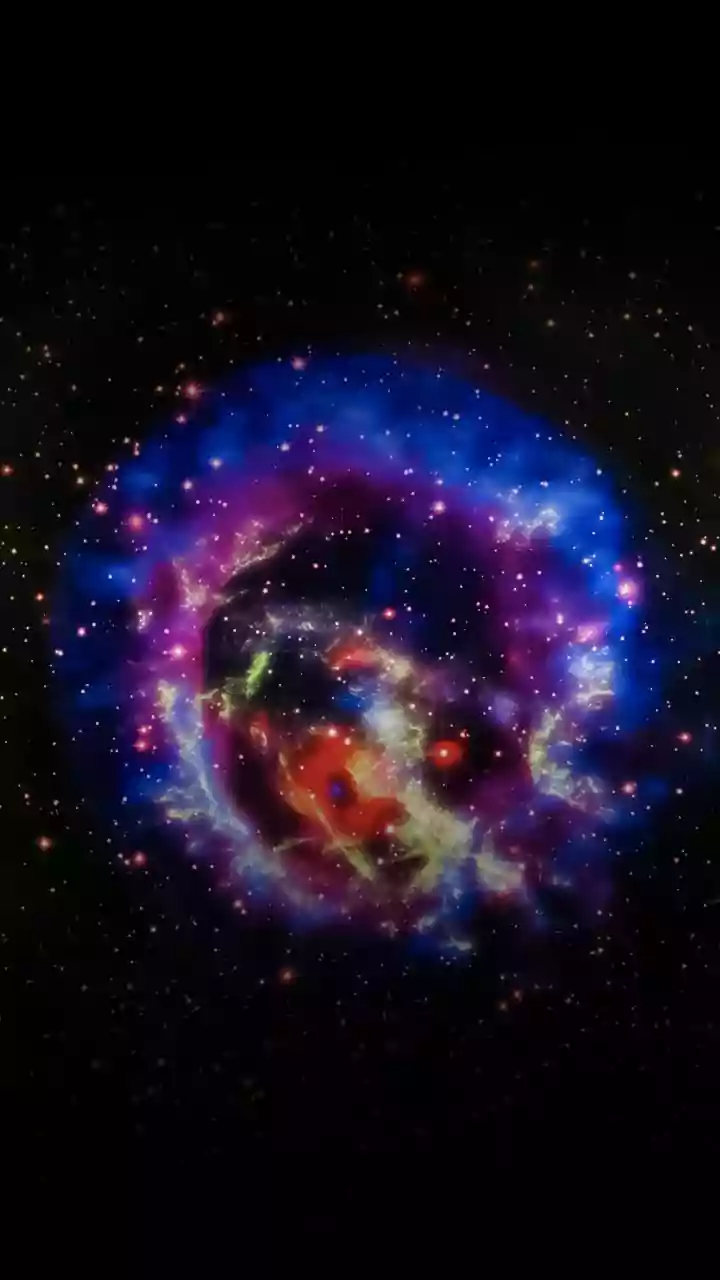
The existence of erythrulose in an interstellar cloud—a stellar nursery where new stars and planets are born—is a critical piece of the puzzle. It shows that these complex molecules are available before planets are even fully formed. Scientists estimate that during a period known as the Late Heavy Bombardment, around four billion years ago, Earth was pelted with comets and asteroids. This cosmic shower could have delivered millions of tonnes of interstellar sugars like erythrulose to Earth's surface. This would have enriched the planet's prebiotic chemical soup, providing a ready-made inventory of the raw materials needed to kick-start metabolic processes and eventually, the first life. Finding these molecules in space helps solve a long-standing problem for origin-of-life researchers: how Earth acquired a sufficient concentration of these vital ingredients.
The Next Frontier for Astrobiology
This finding does not prove that life came from space, but it strongly supports the idea that the ingredients for life are not unique to Earth. They appear to be common throughout the galaxy, forming naturally in the vast clouds between stars. The detection of erythrulose, the largest non-cyclic molecule yet found in interstellar space, pushes the boundaries of what we thought was possible for cosmic chemistry. It encourages scientists to search for even more complex molecules, including other sugars like ribose and perhaps even amino acids, in these stellar nurseries. Each new discovery of a life-related molecule in the cosmos reinforces the idea that the universe could be teeming with the potential for life. The search is no longer just for habitable planets, but for the very seeds from which life might spring.