

How Is 'Powerful' Measured?
When volcanologists talk about the power of an eruption, they often use the Volcanic Explosivity Index, or VEI. It’s a logarithmic scale from 0 to 8, meaning each whole number represents an eruption ten times more explosive than the last. The scale considers
the volume of ejected material, the height of the ash cloud, and how long the eruption lasts. While a high VEI signifies a massive blast, the true impact of an eruption can also be measured by its societal disruption, from grounding global air travel to forcing hundreds of thousands from their homes.
Hunga Tonga-Hunga Haʻapai, Tonga (2022)
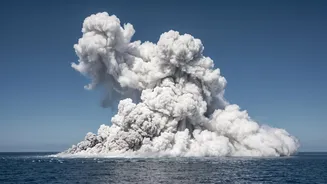
The eruption of the Hunga Tonga-Hunga Haʻapai underwater volcano on January 15, 2022, was the most powerful explosive event of the 21st century, and the largest recorded by modern instruments. Scientists estimate its force was equivalent to hundreds of Hiroshima-sized atomic bombs, with some studies placing its VEI between 5 and 6. The blast sent a plume of ash and water vapor an unprecedented 58 kilometers into the atmosphere, creating atmospheric shockwaves that circled the globe multiple times. The ensuing tsunamis devastated parts of Tonga, with waves reaching up to 15 meters, and were felt across the Pacific, from Japan to Peru. It was a stark reminder that some of the planet's most formidable forces lie hidden beneath the waves.
Eyjafjallajökull, Iceland (2010)
While only rated a VEI 4, the eruption of Iceland's Eyjafjallajökull volcano had an outsized impact that brought the modern world to a standstill. Beginning in April 2010, the eruption occurred beneath a glacier, a combination that produced extremely fine, glassy ash. This ash was particularly hazardous to jet engines, prompting the largest shutdown of European airspace since World War II. For nearly a week, flights were grounded across the continent, affecting millions of travelers and costing airlines billions. The event demonstrated how a relatively moderate eruption in the right place could cause cascading disruptions across globally interconnected systems, changing how the aviation industry assesses volcanic risk forever.
Puyehue-Cordón Caulle, Chile (2011)
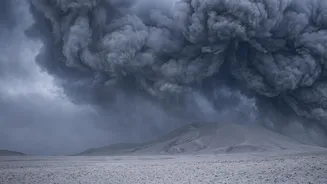
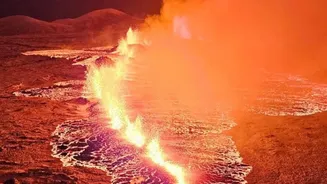
On June 4, 2011, after 51 years of quiet, the Puyehue-Cordón Caulle volcanic complex in Chile unleashed one of the century's largest eruptions, a powerful VEI 5 event. It shot a column of ash 12 kilometers high, ejecting an estimated one hundred million tons of ash, sand, and pumice. The ash cloud was so vast that winds carried it completely around the globe in just two weeks, severely disrupting air travel across the Southern Hemisphere. Flights were cancelled in cities from Buenos Aires and Montevideo to Sydney and Auckland, causing widespread travel chaos. The eruption continued for months, leaving a thick layer of ash on the surrounding landscape and even creating a rare lava flow made of pure obsidian.
Mount Merapi, Indonesia (2010)
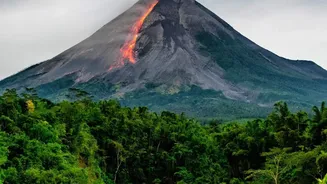
Mount Merapi is one of Indonesia's most active and dangerous volcanoes, and its 2010 eruption was a devastating illustration of why. Beginning in late October, a series of violent explosions with a VEI of 4 unleashed torrents of hot gas and volcanic debris known as pyroclastic flows. These flows moved at terrifying speeds down the volcano's slopes, destroying entire villages. The eruptions killed more than 350 people and forced the evacuation of around 350,000 residents. The ash disrupted air travel across Java and destroyed local agriculture. The Merapi event highlights the most direct and tragic measure of a volcano's power: its immediate threat to human life.