


A New Window on the Cosmos
Named after Nancy Grace Roman, NASA’s first chief of astronomy and the 'mother of Hubble', the Roman Space Telescope is the agency's next great observatory. Launched on August 30, 2026, it is currently on a three-month journey to its operational orbit
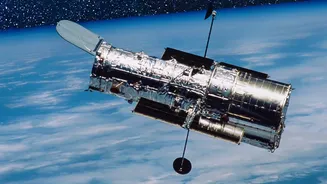
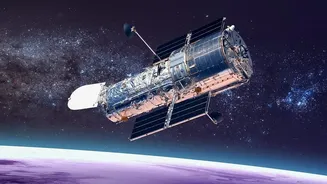
about 1.5 million kilometres from Earth. Unlike its famous predecessors, Hubble and the James Webb Space Telescope (JWST), which act like zoom lenses to study specific cosmic targets in great detail, Roman is a wide-angle survey machine. Its mission is to rapidly map vast stretches of the sky, creating cosmic charts of unprecedented scale and detail that will help tackle some of the biggest questions in astronomy.
The Power of a Panoramic View
Roman's primary mirror is 2.4 meters in diameter, the same size as Hubble's, meaning it can produce images with similar sharpness and detail. The game-changing difference lies in its camera, the Wide Field Instrument (WFI). This instrument gives Roman a field of view at least 100 times greater than Hubble's infrared camera. To put that in perspective, while Hubble might need hundreds of individual snapshots to create a mosaic of a large galaxy, Roman can capture it in just a couple of pointings. This incredible efficiency means Roman can survey huge areas of the universe up to a thousand times faster than Hubble ever could. In its five-year primary mission, it’s expected to observe over a billion galaxies.
Hunting for Dark Energy and Exoplanets
Roman has two main scientific goals. The first is to probe the mystery of dark energy, the enigmatic force causing the universe's expansion to accelerate. By mapping the distribution of billions of galaxies and tracking thousands of stellar explosions called supernovae, scientists can measure how the universe has expanded over time, providing crucial clues about the nature of this force. The second major goal is a census of exoplanets—par. Roman will use a technique called gravitational microlensing, where the gravity of a foreground star or planet bends and magnifies the light from a more distant star. This method is so sensitive it's expected to find thousands of new planets, including rogue planets that drift through space without a host star and worlds as small as Mars.
A Cosmic Companion to Hubble and Webb
Roman isn't a replacement for Hubble or Webb, but a powerful complement. While Roman scans the sky for targets of interest, Hubble and Webb can follow up with detailed observations. For example, Roman might discover thousands of potential planets, and Webb could then study the atmospheres of the most promising ones. In addition to its main survey work, Roman is also testing a groundbreaking piece of technology called a Coronagraph. This instrument is designed to block the overwhelming glare from a star, allowing the telescope to take direct images of the much fainter planets orbiting it. This technology demonstration is a vital stepping stone for future missions that will aim to find and characterize Earth-like worlds.