



A Cosmic Disappearing Act
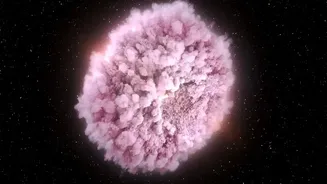
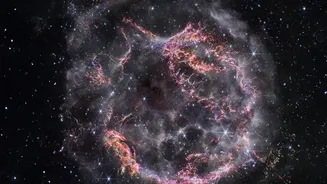
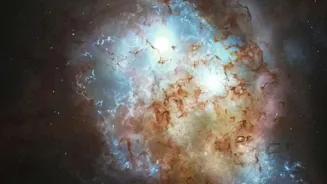
In the vastness of space, the death of a massive star is usually a spectacular event. Stars many times the mass of our sun end their lives in a supernova, a cataclysmic explosion that can briefly outshine an entire galaxy. Astronomers expect to see these
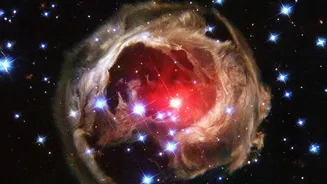
cosmic fireworks from a class of stars known as red supergiants. Yet, for years, they’ve noticed a curious discrepancy: there are fewer visible supernovae from the most massive red supergiants than theories predict. It's as if some of these stellar giants are simply... gone. This phenomenon, where a star seemingly winks out of existence without the expected bang, is what astronomers call a 'failed supernova'. For a distant observer, the star is there one moment and gone the next, leaving behind only a question mark.
The Life and Death of a Titan
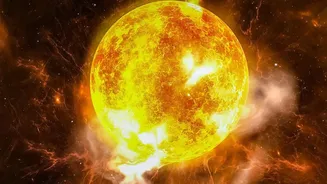
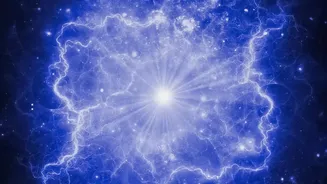
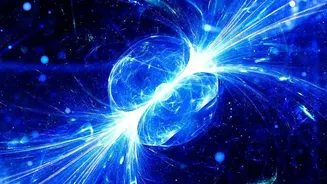
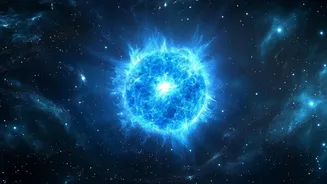
Red supergiants are the largest stars in the universe by volume. If one were placed at the centre of our solar system, it could engulf the orbits of planets as far out as Jupiter. These stars are in their final evolutionary stages, having exhausted the hydrogen fuel in their cores. They swell up, cool down, and begin fusing heavier elements to stave off gravitational collapse. This process can't last forever. Eventually, the core runs out of fuel entirely. When that happens, gravity wins. The star's immense mass comes crashing down on the core in a matter of seconds. Typically, this collapse triggers a powerful shockwave that, with a crucial boost from a flood of particles, blasts the star's outer layers into space in a brilliant supernova.
The Case of the Missing Bang
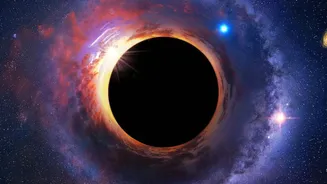
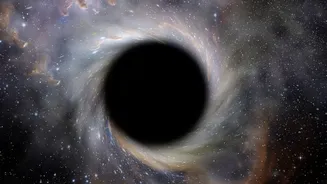
So what happens when the supernova fails? The leading theory is that for the most massive stars—those perhaps 17 times more massive than our sun or greater—the core collapse is so overwhelming that the nascent explosion is snuffed out before it can even begin. Instead of rebounding, the shockwave stalls, and the star continues to collapse inward, directly forming a black hole that consumes the rest of the star. To us, the star just vanishes. This 'direct collapse' model neatly explains the missing supernovae, but the exact mechanism determining which stars explode and which ones implode has been a major puzzle. Another theory suggests that some of these stars become so enshrouded in dust they produce before dying that the final explosion is completely hidden, though recent observations with the James Webb Space Telescope are helping to peer through these dusty veils.
Enter the Ghost Particle
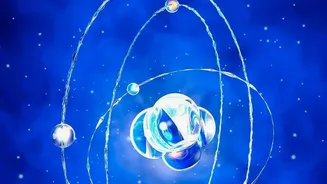
Recent research points to a tiny, almost massless particle as the key decider of a star's fate: the neutrino. Neutrinos, often called 'ghost particles', barely interact with other matter. Trillions pass through your body every second unnoticed. However, a star's core collapse unleashes an almost unimaginable flood of them—they carry away about 99% of the energy from the event. In a successful supernova, it's believed that a tiny fraction of these neutrinos slam into the material behind the stalled shockwave, giving it the extra push needed to trigger the massive explosion. Without that neutrino-powered boost, the explosion fizzles. A new study suggests that the way neutrinos change their 'flavour' or type as they travel can significantly impact this process.
A Collapse, Not an Explosion
There are three types, or 'flavours', of neutrinos: electron, muon, and tau. As they travel, they can oscillate or change from one flavour to another. According to recent simulations, this flavour-changing behaviour within the ultra-dense environment of a collapsing star can make a critical difference. Researchers found that including these flavour conversions in their models made it significantly less likely for many massive stars to explode. A small change in how the neutrinos behave and transfer their energy can decide the fate of the entire star. For a large number of stars that were previously expected to go supernova, these updated models now predict they will fail, collapsing directly into a black hole.
What This Means for Astronomy
This new understanding could solve several cosmic mysteries at once. It helps explain the observed shortage of supernovae from very massive stars and provides a physical mechanism for why some supergiants vanish. It also aligns with the masses of black holes being detected by gravitational wave observatories. A star that collapses directly without a supernova retains all its mass, naturally forming a more massive black hole, which fits with recent observations. While the theory still requires more research and observational evidence, it marks a significant step forward. It shows that the fate of the largest objects in the cosmos might be determined by the behaviour of its smallest, most elusive particles, linking the worlds of astrophysics and particle physics in a profound way.