



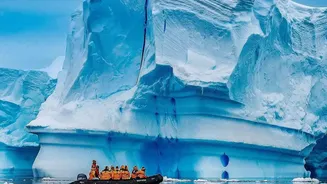
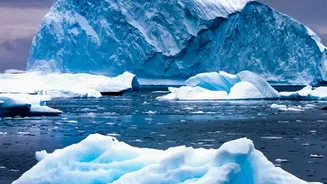
A Continent of Contrasts
Recent headlines about Antarctica can seem contradictory. One study from early September 2026 reported a surprising, short-term gain of 695 billion tons of ice in East Antarctica between 2021 and 2023. This was caused by unusually heavy snowfall, linked
to warm ocean patches thousands of miles away. However, scientists are clear this was a temporary blip, not a reversal of the continent's overall decline. The bigger, more persistent story remains one of net ice loss, particularly in the west, where the most vulnerable glaciers lie. Over the last two decades, Antarctica has lost ice at an alarming pace, and that trend is the focus of long-term concern.
West Antarctica's Point of No Return
The heart of the problem lies in West Antarctica. Several major studies from 2025 and 2026 conclude that parts of the West Antarctic Ice Sheet (WAIS) may have already passed a tipping point. This means their collapse is now likely irreversible over human timescales, regardless of future emissions cuts. The glaciers in this region, like the well-known Thwaites and Pine Island glaciers, are particularly unstable because their bases rest on bedrock that is below sea level and slopes downward inland. As warmer ocean water gets underneath the ice shelves, it melts them from below, causing the grounding line—where the ice starts to float—to retreat. This allows the glaciers to flow faster into the ocean, setting off a self-sustaining feedback loop of melting and retreat.
What the Science Says Now
A landmark study published in March 2026 provided a 30-year record of these retreating grounding lines, finding that nearly a quarter of Antarctica's coastal glaciers are in retreat. The most dramatic changes were in West Antarctica, where the Smith and Thwaites glaciers have pulled back by over 42 and 26 kilometers, respectively. Another modeling study found that even with no additional warming, the current climate may be enough to trigger the collapse of some marine regions of the WAIS over the next 300 to 500 years. The complete collapse of the WAIS would take centuries or millennia, but these new findings suggest the process may already be locked in.
The Impact on Global Sea Levels
The loss of Antarctic ice has one major global consequence: sea-level rise. While the process is slow, the volumes are immense. The total collapse of the West Antarctic Ice Sheet alone contains enough ice to raise global sea levels by over 3 meters, or about 10 feet. Even a partial collapse has serious implications. Projections show that continued melting could contribute significantly to the 1-meter rise in sea levels possible by 2300 under high-emissions scenarios. For the hundreds of millions of people living in low-lying coastal zones, from Mumbai to Miami, this is not an abstract threat. It directly impacts the future viability of their communities, infrastructure, and economies.
A Complicated But Clear Future
While the science is complex, the overarching message from recent studies is one of urgency. While some short-term events like heavy snowfall can temporarily add mass, the long-term trajectory for Antarctica, especially its western half, is one of accelerating loss. Scientists stress that while some level of sea-level rise from Antarctic melt is now committed and unavoidable, aggressive action to cut greenhouse gas emissions is still crucial. Reducing warming could slow the rate of melt, buying precious time for coastal communities to adapt and potentially preventing other vulnerable sections of the ice sheet from crossing their own tipping points.