



High in the Himalayas, a new danger is brewing. As glaciers melt, they are creating thousands of lakes, many held back by fragile natural dams. But the risk isn't from a single type of failure; it's a complex and escalating series of threats.
The Anatomy of a Water Bomb
A Glacial
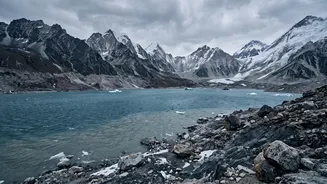
Lake Outburst Flood, or GLOF, is a sudden and catastrophic release of water from a glacial lake. Think of it as a water bomb detonating in the mountains. As climate change accelerates glacier melt, water collects in depressions left by the retreating ice. These lakes are often dammed by nothing more than unstable ridges of loose rock and sediment called moraines. When this natural dam fails, a torrent of water, mud, and boulders can surge down narrow mountain valleys, destroying everything in its path, from villages and roads to major infrastructure like hydropower dams. The 2023 disaster at South Lhonak Lake in Sikkim, which obliterated the Teesta-III dam, is a stark reminder of this power.
More Than One Way for a Dam to Break
The danger of GLOFs lies in their complexity. It is a mistake to think of them as a single, uniform phenomenon. Instead, they are multi-driver hazards where climate warming sets the stage, but the final trigger can be one of many things. The primary dam failure might be simple overtopping, where the lake level rises from extreme rain or rapid melt and spills over the moraine, eroding it. Another mechanism is 'piping,' where water seeps through the dam, gradually weakening it from within until it collapses. Understanding this variety is crucial because it means there is no one-size-fits-all solution for prediction or prevention.
The Domino Effect of Triggers
The immediate cause of a GLOF is often a separate event that sets off a deadly chain reaction. A massive rockfall, ice avalanche, or landslide crashing into a glacial lake can create a huge displacement wave, like a tsunami in the mountains. This wave can easily breach the moraine dam. The Himalayas, being a seismically active zone, also face the threat of earthquakes destabilising the slopes and dams holding these lakes in check. Even extreme rainfall, now more common in a warming climate, can be the final push, saturating the surrounding slopes and leading to a collapse. The 2013 Kedarnath tragedy was a hybrid event, where a cloudburst caused the small Chorabari Tal to breach, unleashing a devastating debris flow.
Cascading Hazards: When One Disaster Fuels Another
The most dangerous scenarios involve cascading hazards. This is when one event triggers another, amplifying the destruction. For instance, a GLOF from an upper lake can crash into a lower lake, causing a combined, much larger outburst. The floodwaters can also pick up enormous amounts of sediment, transforming into a thick, fast_moving debris flow that is far more destructive than water alone. In some cases, a GLOF can block a river downstream, forming a new temporary lake that poses a secondary flood threat when it inevitably breaks, as was feared after a recent GLOF in Bhutan. The 2021 Chamoli disaster in Uttarakhand was not a classic GLOF but a rock_ice avalanche that turned into a debris flow, illustrating a similar and equally deadly cascading effect.
The Threat to the Indian Himalayas
India is acutely vulnerable to this evolving threat, with thousands of glacial lakes dotted across states like Himachal Pradesh, Uttarakhand, Sikkim, and Arunachal Pradesh. Studies have identified hundreds of these as potentially dangerous. Himachal Pradesh has seen its number of glacial lakes nearly double in just four years, from 562 in 2019 to 1,048 in 2023. As development, including vital roads and ambitious hydropower projects, pushes deeper into these fragile valleys, the exposure to risk grows. The challenge is immense: monitoring thousands of remote, high_altitude lakes is a logistical nightmare, and the short warning times for these sudden events leave downstream communities with little time to react.