


Mehrangarh Fort, Jodhpur
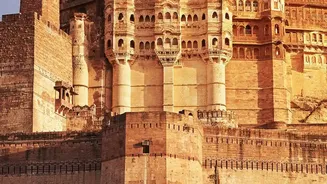
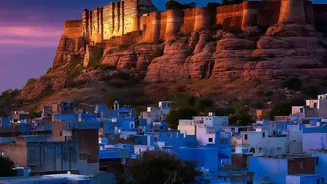
Towering 400 feet above the city of Jodhpur, Mehrangarh Fort is a testament to Rajputana grandeur and military foresight. Founded in 1459 by Rao Jodha, its imposing walls, which are up to 36 meters high, appear to grow organically from the rocky hill
they stand on. Inside, the rugged exterior gives way to a series of exquisite palaces. The Phool Mahal (Palace of Flowers) and the Sheesh Mahal (Hall of Mirrors) showcase the delicate artistry of the Marwar school, with intricate carvings, gilded ceilings, and elaborate mirror work. The fort's architecture is a blend of rugged defense and refined royal living, offering a comprehensive look at the evolution of Rajput design.
Red Fort, Delhi
A symbol of Mughal power and a masterpiece of architecture, the Red Fort (Lal Qila) in Delhi was commissioned by Emperor Shah Jahan in 1639. Designed by Ustad Ahmad Lahori, the architect also credited with the Taj Mahal, it represents the zenith of Mughal creativity. The fort is an exercise in symmetry, built from striking red sandstone and accented with white marble. Its design fuses Persian, Timurid, and Hindu traditions. Within its walls are notable structures like the Diwan-i-Aam (Hall of Public Audience) and the Diwan-i-Khas (Hall of Private Audience), where the famous Stream of Paradise, or Nahr-e-Behisht, once flowed through the pavilions.
Amber Fort, Jaipur
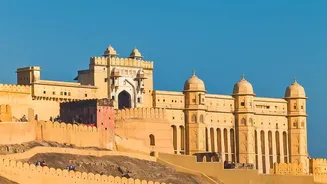
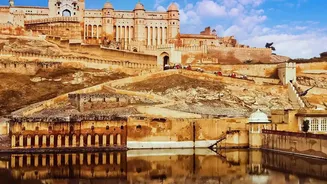
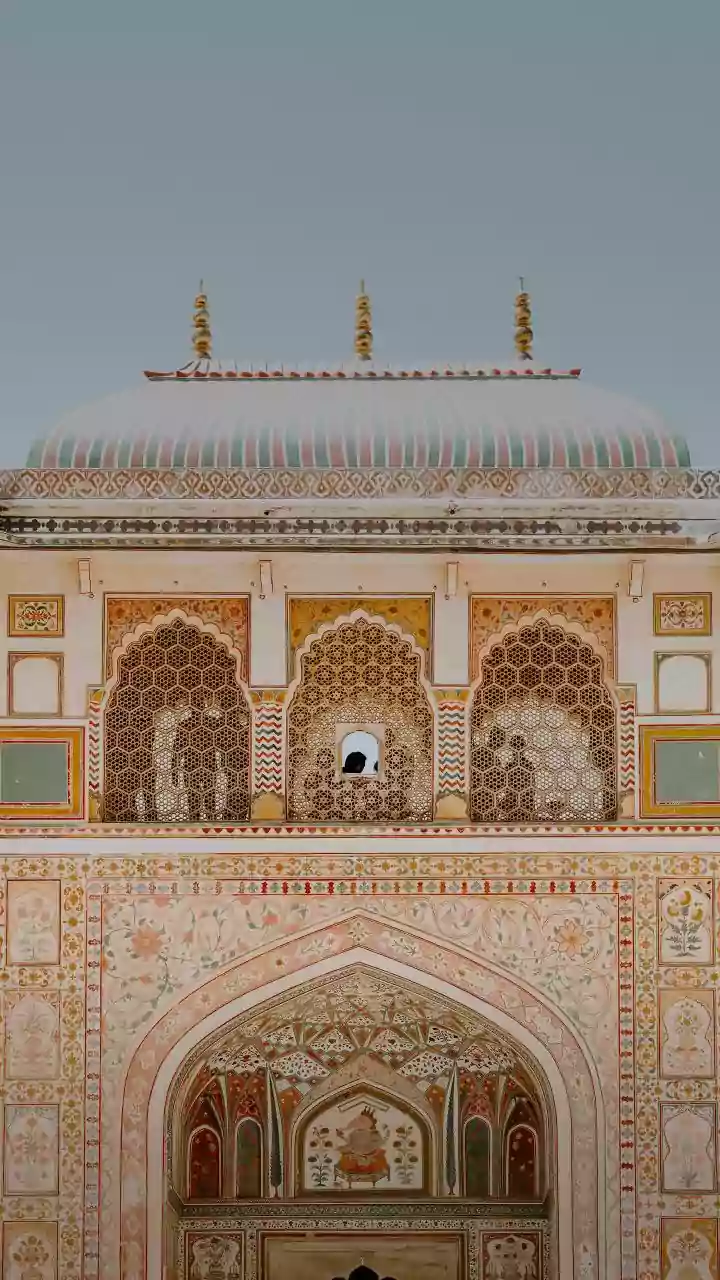
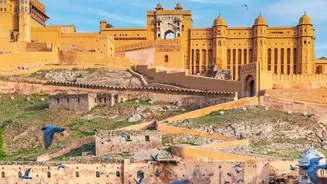
Perched on a forested hill overlooking Maota Lake, Amber Fort is a stunning amalgamation of Rajput and Mughal architectural styles. Constructed with pale yellow and pink sandstone and white marble, the fort is laid out in four distinct levels, each with its own courtyard. Originally built in the 16th century by Raja Man Singh, a trusted general of Emperor Akbar, it was expanded by successive rulers. The fort is renowned for the Sheesh Mahal, a chamber where the walls and ceiling are encrusted with countless mirror pieces that glitter with a single flame. Its serpentine staircases and maze-like passages are a reminder of the opulent lifestyle of the Rajput maharajas.
Gwalior Fort, Madhya Pradesh
Described by the Mughal emperor Babur as "the pearl amongst the fortresses of Hind," Gwalior Fort has a history stretching back to at least the 6th century. Its strategic location on a solitary rock outcrop made it one of India's most invincible forts. The fort complex is a city in itself, containing palaces, temples, and water tanks. Architecturally, it showcases a remarkable diversity. The Teli-ka-Mandir temple blends North and South Indian styles, while the Man Mandir Palace is a celebrated example of early Hindu palace architecture, adorned with colourful tile work. The massive rock-cut Jain sculptures on the way up to the fort add another layer to its rich heritage.
Chittorgarh Fort, Rajasthan
As one of the largest forts in India and a UNESCO World Heritage site, Chittorgarh is more than a structure; it is a symbol of Rajput chivalry and resilience. Sprawling across a 180-meter-high hill, the fort complex covers nearly 700 acres. It contains 65 historic structures, including palaces, temples, and memorials, all enclosed by a 13-km long perimeter wall. The fort is accessed through seven massive gates, each a formidable defensive structure. Key architectural highlights include the Vijay Stambha (Tower of Victory), a nine-story tower dedicated to Vishnu with intricate carvings depicting Hindu deities, and the Padmini Palace.
Jaisalmer Fort, Rajasthan
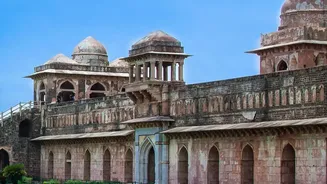
Rising from the heart of the Thar Desert, Jaisalmer Fort is also known as Sonar Quila, or the Golden Fort, because its yellow sandstone walls blend into the desert landscape and glow at sunset. What makes it truly unique is that it is one of the few "living forts" in the world, with a significant portion of the old city's population still residing within its walls. Built in 1156, its architecture is a fusion of Rajput and Mughal styles. The fort is a maze of narrow, winding lanes leading to grand havelis with ornate balconies and latticework, ancient Jain temples with delicate carvings, and the royal palace.
Golconda Fort, Hyderabad
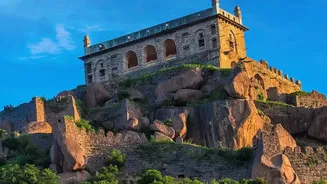
Originally a mud fort, Golconda was transformed into a massive granite fortress by the Qutb Shahi dynasty. The fort is renowned for its ingenious engineering, particularly its acoustic system. A handclap at the main gate, the Fateh Darwaza, can be heard clearly at the Bala Hisar pavilion, the highest point nearly a kilometre away, a feature designed as an early warning system. The architecture is primarily defensive, with concentric fortified walls, 87 bastions, and eight gates. It represents a blend of Hindu and Persian architectural influences, showcasing the Deccan region's unique cultural synthesis.