






Not Fire, Not a Rainbow
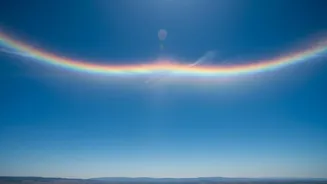
The captivating image, featured as NASA's Astronomy Picture of the Day for August 2, 2026, shows what looks like a vibrant, flame-coloured smear across the sky. While the term 'fire rainbow' is wonderfully descriptive, the phenomenon is neither. Its scientific
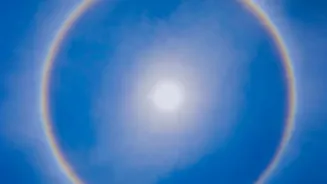
name is a circumhorizontal arc, and it belongs to a family of optical events called ice halos. Unlike a traditional rainbow formed by the refraction and reflection of light in liquid water droplets, a circumhorizontal arc is created by light passing through ice crystals. And while it shows a spectrum of colours, its shape and formation process set it apart.
A Perfect Recipe of Sun and Ice
For a circumhorizontal arc to appear, the sky needs a very specific set of ingredients. First, you need high-altitude cirrus clouds, the thin, wispy clouds found miles above the Earth. These clouds must contain plate-shaped hexagonal ice crystals, which need to be oriented horizontally, like countless tiny floating plates. Second, the sun must be very high in the sky, at an altitude of at least 58 degrees above the horizon. When these conditions align, sunlight enters the vertical side of an ice crystal and exits through its horizontal bottom face. This 90-degree bend acts like a prism, splitting the light into its brilliant component colours and projecting a wide, colourful band parallel to the horizon.
Why Are They So Rare?
The strict requirements for both the sun's angle and the specific type of ice crystals make seeing a circumhorizontal arc a special event. The need for the sun to be higher than 58 degrees means they are impossible to see in locations north of 55°N or south of 55°S. For mid-latitude locations, like much of India and the United States, they are primarily a summer phenomenon that can only occur for a few hours around midday. Even with the sun in the right position, you still need the right kind of cirrus clouds with correctly aligned ice crystals, which is not always a guarantee. The fleeting nature of these clouds often means that only fragments of the arc are visible at any given time.
A Fresh Look at Atmospheric Optics
While the science behind circumhorizontal arcs is well-understood, each stunning new image, like the one shared by NASA, serves as a powerful reminder of the intricate beauty of atmospheric optics. The headline's 'new reason to review ice crystals' isn't about a groundbreaking discovery, but rather a renewed appreciation for these natural prisms. Such clear and vibrant images are valuable for science communicators and educators, offering a perfect, real-world example of light refraction. For skywatchers, they reignite the passion for looking up and understanding the physics at play. They prompt us to reconsider the seemingly empty sky as a dynamic canvas where light, water, and ice constantly interact to create moments of unexpected wonder.