




Meet Our Cosmic Neighbor
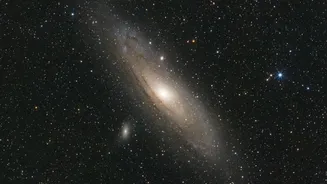
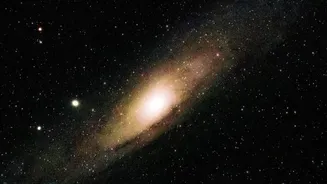
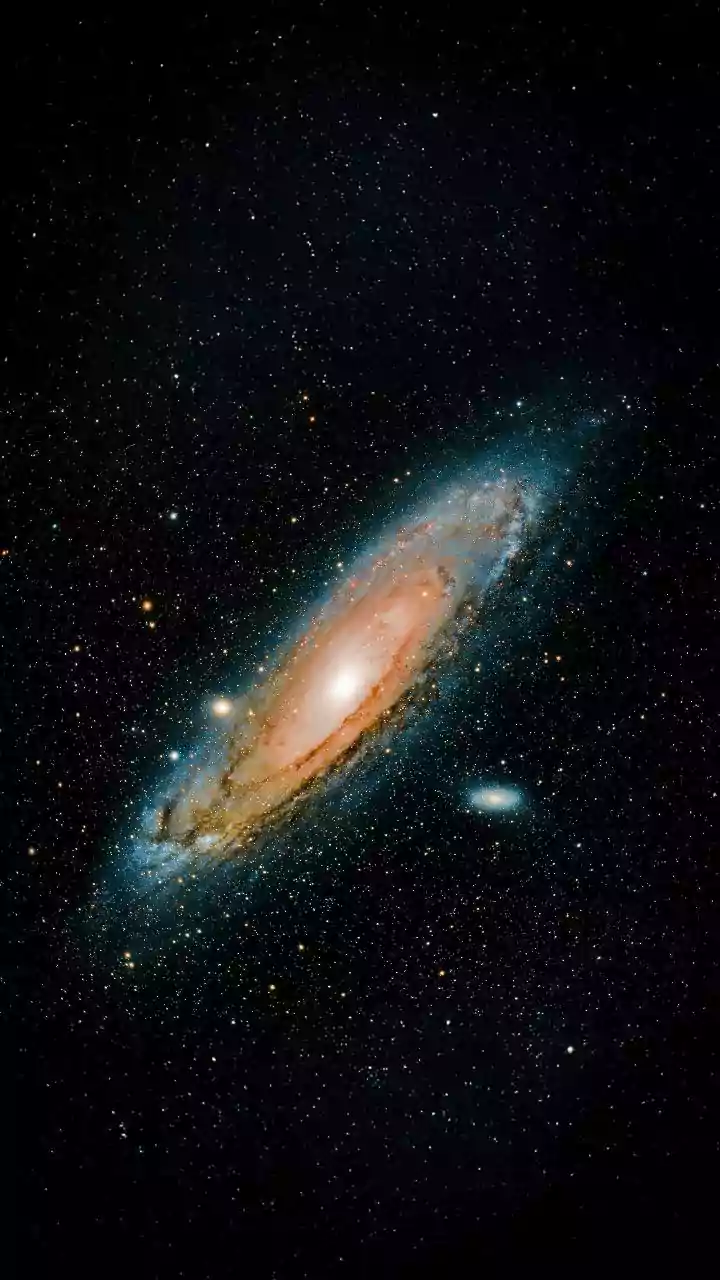
Just 2.5 million light-years away, the Andromeda galaxy (M31) is the closest major galaxy to our own Milky Way. On a clear, dark night, it’s visible to the naked eye as a faint, fuzzy patch of light. But to astronomers, it’s a full-scale cosmic laboratory.
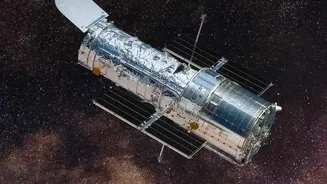
Because of its proximity and size, which is comparable to the Milky Way, telescopes like Hubble can resolve individual stars within it. This provides an external vantage point that’s impossible to get from inside our own galaxy, allowing scientists to study the grand structure and life story of a spiral galaxy like ours in stunning detail. This unique perspective is crucial for piecing together the story of galactic evolution.
A Cosmic Census of 200 Million Stars
To understand Andromeda's history, astronomers undertook a colossal project using the Hubble Space Telescope. By combining data from two massive surveys—the Panchromatic Hubble Andromeda Treasury (PHAT) and its southern counterpart (PHAST)—they created an unprecedented map covering roughly two-thirds of the galaxy’s star-forming disk. This effort cataloged around 200 million individual stars. Stars act as a galaxy's fossil record. Massive stars burn hot and blue but die quickly, signaling recent star birth. Less massive, redder stars live much longer, indicating older populations. By analyzing the mix of stars in thousands of different regions, scientists can rewind the clock and reconstruct Andromeda's star-making activity over millions of years.
The Star-Formation Slowdown
The study's main finding is a clear and steady decline in star formation over the last 500 million years. Two billion years ago, Andromeda experienced a major burst of star creation, likely from a merger with another galaxy. But since then, things have been winding down. About 500 million years ago, Andromeda was creating stars at a rate of about one solar mass (the mass of our Sun) per year—similar to the Milky Way's current rate. By 40 million years ago, that rate had dropped by half. Today, it has plummeted to just one-fifth of a solar mass per year, signaling a significant shift into a quieter phase.
A Fading Ring of Fire
This slowdown isn't happening uniformly across the galaxy. Much of Andromeda's recent star birth has been concentrated in a massive ring of gas and dust located about 32,000 light-years from the galactic center. This ring has been the galaxy's most productive stellar nursery. Now, as the activity in this dominant ring fades, it is dragging the whole galaxy's average rate down with it. Interestingly, the cause isn't a lack of raw material. The gas and dust are still there. Instead, scientists believe the galaxy is simply in a natural winding-down period after its earlier, more energetic burst of activity. As one researcher put it, after running a cosmic marathon, the galaxy is taking a breather.
The Mysterious Role of a Companion
As astronomers investigated the slowdown, one area stood out. A small satellite galaxy, M32, appears close to Andromeda's disk. While its exact position and past interactions are uncertain, the new Hubble data shows that the part of Andromeda's disk nearest to M32 experienced a more pronounced drop in star formation starting about 60 million years ago. While scientists can't definitively say M32 is the cause, the timing and location make it a prime suspect for this localized quiet patch. Teasing out this potential connection could help explain how interactions between galaxies, even small ones, can shape their evolution.