





The Ghost Particle
First, let's talk about the messenger. The discovery hinges on a particle called a neutrino. Neutrinos are fundamental particles, like electrons or quarks, but they are famously elusive. They have almost no mass, no electric charge, and interact so weakly
with other matter that billions of them pass through you every second without a trace. This trait makes them nearly impossible to detect, but it also makes them perfect cosmic messengers. While light can be blocked by dust or gas, neutrinos can travel across billions of light-years in a straight line, carrying information directly from the heart of the most violent events in the universe. Detecting them is a monumental task. The IceCube Neutrino Observatory, which made this particular detection, uses a cubic kilometer of pristine Antarctic ice as its detector. When a high-energy neutrino happens to strike an atom in the ice, it creates a faint flash of blue light that can be traced back to its direction of origin.
Meet the 'Shadow Blaster'
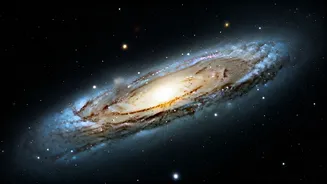
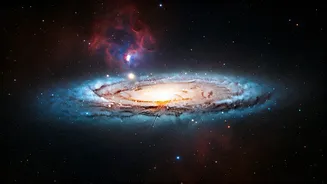
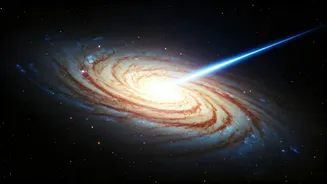
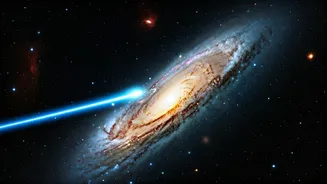
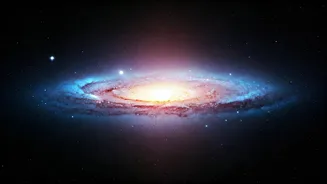
The neutrino detected on September 22, 2021, named IC 210922A, pointed astronomers to a fascinating and unexpected source. After IceCube sent out an alert, telescopes around the world scrambled to observe the patch of sky the particle came from. They found a very bright, but extremely dusty, galaxy nicknamed the "Shadow Blaster." Its official name is JCMT0402-0424, and it's located about 11 billion light-years away. The "dusty" and "shadow" parts of its nickname come from the fact that it is so obscured by its own material that it's nearly invisible in optical light. What makes this galaxy special is that it’s a “starburst” galaxy, meaning it’s forming new stars at an incredibly intense rate. Intriguingly, follow-up observations showed no signs of a supermassive black hole actively feeding at its center, which is the usual suspect for creating such high-energy particles.
A New Kind of Cosmic Engine
Previously, the few high-energy neutrinos that have been traced to a source were linked to blazars. A blazar is a galaxy with a supermassive black hole at its core that is actively devouring matter and shooting a colossal jet of particles and energy directly at Earth. These jets are considered powerful cosmic accelerators, capable of generating high-energy neutrinos. The Shadow Blaster discovery, however, points to a different kind of engine. Instead of a single, monstrous black hole, the intense environment within this compact, star-forming galaxy seems to be the source. The high density of gas and the violent feedback from countless young, massive stars creates a natural particle accelerator. Energetic particles, like protons, are bounced around within this cosmic pinball machine, eventually colliding with gas to produce the high-energy neutrino that traveled all the way to Earth.
Why This Discovery Matters
This finding is a landmark for multi-messenger astronomy, a field that combines data from different cosmic "messengers"—like light, gravitational waves, and particles like neutrinos—to get a complete picture of an event. By tracing a neutrino to a starburst galaxy, scientists have identified a new class of cosmic particle accelerators. Until now, blazars were the primary candidates. Now, it seems that these intensely star-forming regions could be responsible for a significant portion, perhaps up to 20%, of the universe's background hum of high-energy neutrinos. This discovery helps solve a long-standing mystery about where the universe's most energetic particles come from. It also opens a new window into "Cosmic Noon," the period around 11 billion years ago when star formation across the universe was at its peak. Neutrinos, by escaping these dusty cauldrons, give us a direct view into the physics of this crucial era of galaxy evolution.