







The Tale of an Immortal Demon
The primary story behind the apprehension surrounding eclipses comes from Hindu mythology, specifically the Samudra Manthan, or the churning of the cosmic ocean. According to the legend, the devas (gods) and asuras (demons) worked together to churn the ocean to produce
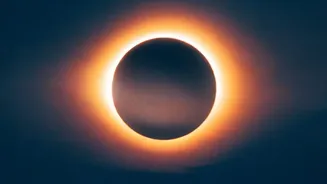
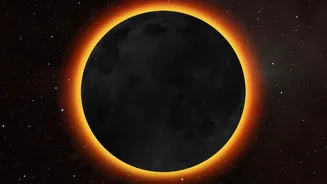
Amrita, the nectar of immortality. When the nectar emerged, Lord Vishnu took the form of a beautiful woman, Mohini, to trick the asuras and distribute it only among the gods. However, one clever asura named Svarbhanu disguised himself as a god and sat between Surya (the Sun God) and Chandra (the Moon God) to receive a sip of the nectar. The Sun and Moon gods spotted the imposter and alerted Vishnu, who swiftly decapitated Svarbhanu with his Sudarshana Chakra. But having already tasted the immortalising nectar, the demon's head and body survived as separate, immortal entities. The head became known as Rahu, and the headless body as Ketu. To exact their revenge on the celestial bodies that exposed them, Rahu and Ketu perpetually chase the Sun and Moon. A solar eclipse is believed to happen when Rahu 'swallows' the Sun, and a lunar eclipse occurs when he swallows the Moon. Since Rahu has no body, the Sun or Moon eventually emerges, ending the eclipse.
When the Stars Turn Unfavourable
This mythological story is deeply intertwined with Vedic astrology, or Jyotisha, which forms an integral part of daily life and tradition in India. In astronomical terms, Rahu and Ketu are not planets but the northern and southern lunar nodes—the two mathematical points where the Moon's orbit intersects the Earth's orbit around the Sun. Eclipses can only occur when the Sun and Moon are aligned near one of these nodes. In Jyotisha, the Sun represents the soul, vitality, and the self, while the Moon governs the mind, emotions, and consciousness. During an eclipse, the light from these life-giving luminaries is temporarily blocked by the shadow entities of Rahu and Ketu, which is considered highly inauspicious. This period is seen as a time when negative energies are more potent, and the natural cosmic order is disturbed. Consequently, it is believed that any important activity or new venture—be it a marriage, a business deal, or a journey—started during an eclipse is destined for instability and failure.
A Time for Caution and Cleansing
Stemming from these beliefs is a host of traditional practices and taboos observed across India during a grahan (eclipse). Many people stay indoors to avoid exposure to the supposedly harmful energies. Temple doors are often closed, as it is believed the divine energy of the idols is disturbed. One of the most common practices is fasting. People avoid cooking and eating during the eclipse, believing that the absence of sunlight allows harmful microorganisms to multiply, rendering food impure or even poisonous. Any leftover food might be protected by placing leaves of Tulsi (holy basil) in it. Pregnant women are especially advised to take precautions, such as staying indoors and refraining from using sharp objects like knives, out of a belief that it could harm the unborn child. Once the eclipse is over, a period of purification begins. Many people take a ritual bath, change into fresh clothes, and clean their homes, sometimes sprinkling Ganga jal (water from the Ganges River) to wash away any lingering negative influences.
Ancient Beliefs in a Modern World
In contemporary India, a fascinating dichotomy exists. While scientific explanations for eclipses are widely understood and taught, these age-old traditions continue to hold significant sway. For millions, observing these rituals is not about rejecting science but about respecting cultural heritage and faith. It’s a way to feel connected to a rich tapestry of stories and traditions passed down through generations. Even some who don't strictly adhere to all the rules may choose to postpone important events or perform small acts of prayer, reflecting the deep cultural resonance of these beliefs. The reluctance to watch an eclipse, therefore, is less about a fear of the physical event and more about a profound cultural and spiritual understanding of the cosmos—one where mythology, astrology, and daily life are inextricably linked. It is seen as a powerful, sacred time best suited for introspection, prayer, and spiritual practices like chanting mantras, rather than for outward observation.