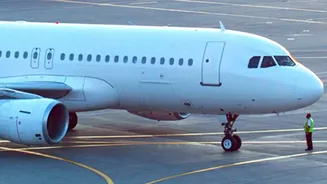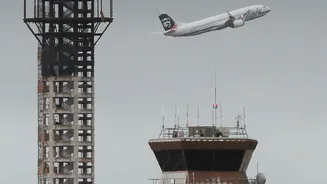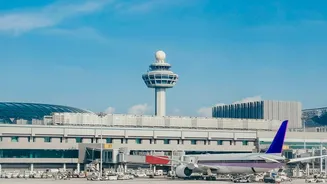



A single piece of hardware may be responsible for grounding flights across the country, snarling travel for millions. FAA investigators are now zeroing in on a faulty router as the likely trigger for the recent nationwide aviation shutdown.
What Exactly Happened?
On Friday,
November 13, the Federal Aviation Administration (FAA) took the rare step of issuing a nationwide ground stop, halting all departing flights across the United States for nearly five hours. The order was issued out of an abundance of caution after the agency's systems began experiencing severe instability, affecting 17 of its 22 Air Route Traffic Control Centers. These centers are the nerve centers of aviation, managing aircraft at high altitudes between departure and arrival. While approximately 3,500 planes already in the air were able to land safely, the shutdown caused a cascade of over 12,000 cancellations and thousands more delays that rippled through the weekend, costing major airlines an estimated $345 million. Officials were quick to state that there was no evidence of a cyberattack.
A Faulty Router Takes Center Stage
The focus of the investigation has quickly narrowed to a seemingly routine but critical piece of technology: a network router. Preliminary findings point to a newly installed router at a radio communications site in El Dorado, Arkansas, where a contractor, L3Harris, was performing upgrades. The work involved replacing old copper wiring with modern fiber-optic lines, a process that has been ongoing for years. According to the FAA, the system's legacy equipment became unstable when the network was flooded with data 'at a rate of 1,000 connection attempts every 4 to 5 seconds'. This data deluge, traced to the new router installation, is believed to have overloaded the system, creating instability in vital aircraft communications and radar feeds. A similar issue was linked to a radar site in Amarillo, Texas.
A System Under Strain
This incident has cast a harsh spotlight on the age and fragility of the nation's critical aviation infrastructure. Transportation Secretary Sean Duffy blamed the disruption on an 'incredibly old' air traffic control system being overwhelmed by the introduction of new technology. This wasn't a failure of the newer Notice to Air Missions (NOTAM) system, which caused a shorter ground stop in January 2023, but rather the underlying telecommunications network that connects everything. Government watchdogs have issued warnings for years. A Government Accountability Office report noted that of 138 critical FAA systems, 51 were deemed 'unsustainable' due to aging technology. Experts note the immense challenge of upgrading a complex system that must operate 24/7, where old and new technologies have to work together perfectly.
The Investigation and Next Steps
The router believed to be at the heart of the failure has been sent to a lab for analysis, with the FAA, contractor L3Harris, and even the FBI participating in the investigation to rule out any nefarious activity. As a precaution, the FAA has paused further router installations and disabled certain functionalities on approximately 60 similar routers across the network. The incident has prompted calls for a massive injection of funding. The administration is now asking Congress for over $50 billion to overhaul the air traffic control system, arguing that patchwork fixes are no longer sufficient. However, the request has been met with some skepticism from lawmakers who question the total amount and suggest the airline industry should help cover the costs.
What This Means for Travelers
While operations have returned to normal, the event serves as a stark reminder of how dependent modern air travel is on a complex and sometimes vulnerable web of unseen technology. For now, the immediate impact has subsided, but the incident raises questions about the system's resilience, especially ahead of major travel holidays. Secretary Duffy could not guarantee that a similar failure would not happen again without significant upgrades. The investigation's final report, expected soon, will be crucial in determining whether this was an isolated case of human error or faulty equipment, or a deeper symptom of a system in desperate need of modernization. For passengers, the key takeaway is that the complex system that ensures their safety is undergoing a difficult and sometimes disruptive transition.