






The Universe's Invisible Scaffolding
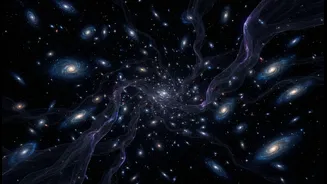
Imagine trying to understand a city by only looking at its streetlights. You’d miss the roads, the buildings, and the ground everything is built on. In cosmology, the stars and galaxies we see are just the streetlights. The vast, invisible structure they
rest upon is dark matter. Scientists know it exists because of its gravitational pull; without it, galaxies would spin themselves apart, and clusters of galaxies would drift away from each other. The problem is, this stuff is completely invisible. It doesn’t emit, reflect, or block light. It accounts for about 85% of all matter, yet we have no idea what it is. This glaring gap in our knowledge is one of the biggest mysteries in all of science.
The Frustrating Hunt for WIMPs
For a long time, the leading suspect for dark matter was a hypothetical particle called a WIMP, or Weakly Interacting Massive Particle. The theory was elegant: in the hot, dense early universe, WIMPs would have been created in just the right amount to explain the abundance we see today, a phenomenon called the "WIMP miracle." Then, as the universe expanded and cooled, they would mostly stop interacting, explaining their present-day invisibility. Physicists built incredibly sensitive detectors, often deep underground, to catch the fleeting signature of a WIMP bouncing off a regular atom. But after decades of searching, they have found nothing. This lack of evidence has thrown the field into a quiet crisis, prompting scientists to explore more creative, and some might say radical, ideas.
A New Hiding Place: The Fifth Dimension
A new theory from researchers at the University of Sheffield proposes a radical new hiding place for dark matter: a hidden extra dimension. While our universe is described by four dimensions (three of space and one of time), some theories in fundamental physics predict the existence of more. This new study suggests that dark matter particles, and a hypothetical force-carrying particle called a 'dark photon', exist primarily within this compact fifth dimension. This isn't just a random guess; the geometry of this extra dimension provides a natural and elegant explanation for dark matter's perplexing behaviour.
Solving Abundance with Cosmic Resonance
The key to this new theory is a concept called 'resonance.' The researchers compare it to a musical instrument vibrating when the right note is played. They propose that the specific geometry of the hidden dimension naturally 'tunes' the masses of dark matter particles and dark photons into a perfect resonance. In the extreme conditions of the early universe, this resonance would have been active, causing dark matter to interact strongly with itself. This strong interaction is crucial because it would have allowed for the production of dark matter in the exact quantities needed to match the abundance we observe today, solving the first major piece of the puzzle without any artificial fine-tuning.
Explaining Invisibility Through a Fading Echo
If dark matter interacted so strongly in the past, why is it virtually invisible to us now? The same resonance provides the answer. As the universe expanded and cooled, the conditions changed. The 'note' of the cosmos is no longer being played, so the resonance has faded. Without this resonant amplification, the interactions between dark matter and our familiar world have become incredibly weak—so weak that our most sensitive experiments have been unable to detect them. In this way, the theory elegantly explains both sides of the coin: a strong interaction in the past to create the right abundance, and a feeble interaction in the present to explain its invisibility and elusiveness.
What Happens Next in the Search?
Perhaps the most exciting part of this new framework is that it isn't just a philosophical exercise. By linking the mystery of dark matter to the existence of a hidden dimension, it provides physicists with clear new targets. Future experiments could be designed to look for the specific signatures predicted by this model, such as subtle effects from dark photons or other phenomena related to extra dimensions. While finding direct proof will be a monumental challenge, this theory shifts the search from a vague hunt for any particle to a focused search for signs of a whole new aspect of reality. The hunt for dark matter is no longer just about finding a particle; it's about mapping the true geometry of our universe.