






First, What Is Computational Biology?
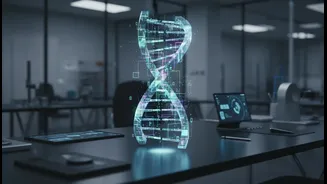
Before diving into how artificial intelligence is changing it, it’s helpful to understand what computational biology is. In essence, it's a field that uses computers to understand biology. Scientists in this area don't just use microscopes; they use code
and algorithms. They analyze enormous datasets—like the entire human genome, protein structures, or vast collections of medical records—to find patterns and make discoveries. This could mean identifying a genetic marker for a disease or simulating how a new drug might interact with a protein. It's a discipline built on the combination of deep biological knowledge and strong programming skills.
Enter the AI Research Assistant
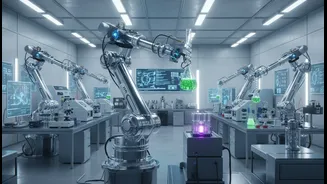
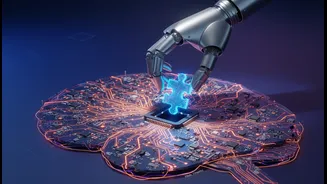
The new players in this field are AI research assistants, often powered by the same kind of large language models (LLMs) behind tools like ChatGPT, but sometimes much more specialized. These aren't robots in lab coats. They are sophisticated software tools designed to assist with the entire scientific workflow. For a young scientist, this AI can act as a 24/7 tutor, helping to debug Python code, summarize complex research papers in seconds, or suggest a statistical method for a tricky dataset. More advanced systems can even help generate new hypotheses or design experiments, acting as a tireless collaborator that can process information far beyond human capacity.
The Promise: An Accelerator for Discovery
The potential benefits for a student or early-career researcher are immense. Traditionally, learning computational biology involves a steep learning curve, requiring mastery of both biology and coding. AI assistants can flatten that curve. By handling repetitive and time-consuming tasks, they free up young scientists to focus on the bigger picture: asking the right questions and designing clever experiments. An AI can provide instant feedback, explain a complex concept in different ways, or generate code snippets, which can dramatically speed up the learning process and a researcher's overall productivity. This could allow them to tackle more ambitious projects sooner and contribute to meaningful discoveries faster.
The Peril: The Risk of a Skills Gap
However, this new paradigm also introduces significant risks. The primary concern among educators is the potential for deskilling. If an AI writes and debugs the code, do students ever truly learn the fundamentals? Relying too heavily on these tools without understanding the underlying principles could create a generation of scientists who are experts at prompting an AI but are lost when the tool fails or produces a subtle, hard-to-spot error. AI models are known to 'hallucinate' or generate plausible-sounding but incorrect information, which could be disastrous in a scientific context if not caught by a discerning human expert. The fear is creating a dependency that undermines the critical thinking and problem-solving skills that are the bedrock of good science.
A New Skill Set for a New Era
The most likely future isn't one where AI replaces scientists, but one where the definition of a successful scientist evolves. The key skill may no longer be the ability to write flawless code from scratch, but rather the ability to expertly guide, validate, and integrate the work of an AI partner. This requires a different, arguably higher-level, set of skills: deep domain knowledge to spot when an AI's output is biologically nonsensical, strong critical thinking to design effective prompts, and methodological rigor to verify the AI's results. Educational institutions and research labs are now grappling with how to adapt their training programs to teach this new form of AI literacy alongside foundational scientific principles.