






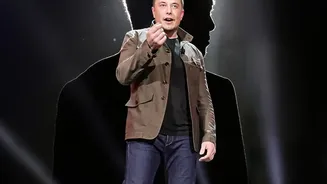
Musk's Declaration of Dash Discontent
In a recent post on his social media platform, X, Elon Musk took a brief detour from tech and space exploration to weigh in on a subject dear to writers and editors: the dash. Responding to another user's post that used em dashes (—), Musk declared his preference
for a shorter alternative. He argued that the em dash, a long line used for parenthetical statements, too closely resembles a hyphenated word and is 'unpleasantly long'. His suggestion? The 'en dash' (–), a slightly shorter line, is a 'better length'. He also advocated for spaces around dashes to improve readability, a stylistic choice that pits different style guides against each other. It was a simple, off-the-cuff remark, but it tapped into a long-simmering debate among those who care deeply about the little lines that hold our sentences together.
A Tale of Three Dashes
To understand Musk's point, one must first appreciate that not all dashes are created equal. The dash family has three main members, each with a specific job. First, there's the hyphen (-), the shortest of the trio. Its primary role is to join words together, as in 'state-of-the-art' or 'mother-in-law'. Next up is the en dash (–), named because it is roughly the width of the letter 'N'. The en dash is a connector, primarily used to indicate a range of values, like 'pages 10–15' or 'the years 2024–2026'. Finally, we have the em dash (—), the longest of the three and the subject of Musk's critique. Named for its width, which approximates the letter 'M', the em dash is a versatile and dramatic mark. It can be used to set off a clause for emphasis, indicate a sudden break in thought, or replace commas, colons, or parentheses. It’s a powerful tool, meant to make a statement—which is precisely why it’s so divisive.
The Great Dash Debate
Why do people have such strong feelings about a punctuation mark? The debate over the em dash is really a debate about style and tone. Proponents see it as an elegant and impactful tool. It creates a longer, more deliberate pause than a comma, adding rhythm and flair to prose. It allows a writer to insert an abrupt aside or a dramatic amplification—a 'look over here!' for the reader. However, critics, including Musk, find it visually disruptive and often overused. Some writers sprinkle em dashes so liberally that sentences lose their structure, becoming a series of disjointed thoughts. The rise of artificial intelligence has also, curiously, cast suspicion on the em dash. Some studies and observations note that AI-generated text tends to use the em dash more frequently than human writers, leading some to view it as an 'AI tell'.
Punctuation in the Digital Age
Musk's preference for brevity and clarity aligns with broader trends in digital communication. On platforms like X, where character counts matter, and on messaging apps, language is constantly evolving to be more efficient. Traditional punctuation rules are often bent or broken to create a specific online voice or tone. A period at the end of a text, for instance, can be perceived as passive-aggressive, whereas its absence is seen as neutral. In this context, Musk’s critique can be seen as more than just a personal preference. It reflects a mindset geared toward optimisation and efficiency, where every character and every pixel on a screen serves a purpose. For a man who has expressed a belief in concise communication, an 'unpleasantly long' line of ink or pixels is simply inefficient design.