


Seeing the Invisible Universe
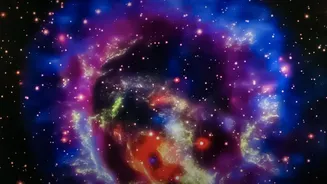
Much of the universe is hidden from our view. The light that human eyes can perceive is only a tiny fraction of the total electromagnetic spectrum. Beyond the red light we can see lies infrared, a type of light that is imperceptible to us but carries
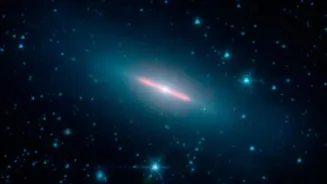
a wealth of information about the cosmos. Think of it as cosmic 'heat vision'. Cooler objects, like planets and dim stars, don't shine brightly in visible light but still glow at infrared wavelengths. Furthermore, as the universe expands, light from the most ancient and distant galaxies gets stretched out during its long journey to us, shifting from visible or ultraviolet light into the infrared range. By building telescopes that can detect this light, astronomers can effectively look back in time to study the early universe.
Piercing Through Cosmic Dust
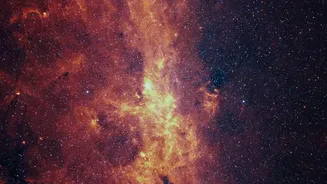
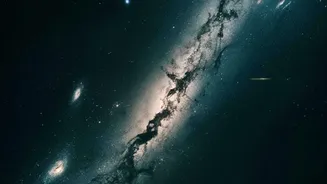
Our galaxy, the Milky Way, is filled with vast clouds of gas and dust. These clouds act like a thick fog, blocking visible light and obscuring our view of what lies within and beyond them, such as newborn stars or the galactic center. Infrared light, however, has a longer wavelength that allows it to slip past these tiny dust particles more easily than shorter-wavelength visible light. This makes infrared astronomy essential for studying regions of star formation, which are typically shrouded in dust. The Nancy Grace Roman Space Telescope, with its powerful infrared capabilities, will be able to pierce through these cosmic curtains, revealing delicate structures and countless stars that would otherwise remain hidden.
Roman’s Powerful Infrared Eye
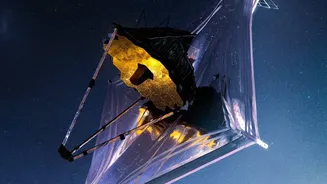
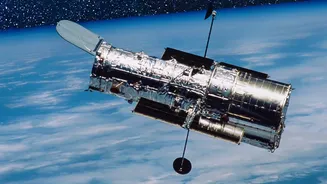
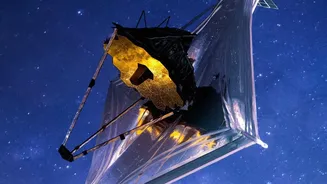
At the heart of the Roman Space Telescope is the Wide Field Instrument (WFI), a 300-megapixel camera designed to survey the sky in near-infrared light. It observes wavelengths from 0.5 to 2.3 microns, a range that allows it to conduct its primary science goals. While Roman’s 2.4-meter primary mirror is the same size as the Hubble Space Telescope's, its WFI provides a field of view that is at least 100 times larger. This immense panorama means Roman can map vast stretches of the sky with the same sharp resolution as Hubble but far more quickly. In its initial five-year mission, Roman is expected to image more than 50 times the area of the sky that Hubble has covered in over three decades.
Answering Astronomy's Biggest Questions
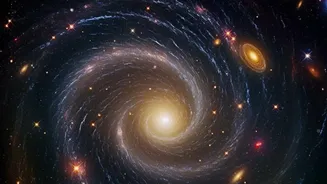
This combination of infrared sensitivity and wide-angle vision makes Roman a unique tool for tackling some of the biggest mysteries in astrophysics. One of its key objectives is to study dark energy, the mysterious force causing the universe's expansion to accelerate. By surveying billions of galaxies and thousands of distant supernovae, Roman will create a massive 3D map of the universe, allowing scientists to trace the history of cosmic expansion and the influence of dark energy over time. The telescope will also conduct a massive census of exoplanets, using a technique called gravitational microlensing to find thousands of worlds, from gas giants to small rocky planets. Its infrared vision is crucial for these goals, helping to build enormous datasets that are essential for understanding the large-scale structure of the cosmos and our place within it.