




A Landmark Moment Years in the Making
The announcement that India's first bullet train will hit the tracks for testing in 2027 marks a pivotal moment for the nation's most ambitious infrastructure project. According to Union Railway Minister Ashwini Vaishnaw, trials are expected to commence
around May or June 2027. This isn't just a test of a single train; it's the culmination of years of planning, complex construction, and international cooperation. The project, officially known as the Mumbai-Ahmedabad High-Speed Rail (MAHSR) corridor, has been steadily progressing, with significant construction milestones being achieved. The 2027 trial will be the first time a Shinkansen-technology train runs on Indian soil, representing a significant technological leap. While the full 508-kilometre corridor connecting Mumbai with Ahmedabad is slated for completion in later phases, the initial trials will pave the way for a phased commercial rollout, possibly within months of successful testing.
What a Trial Run Actually Involves
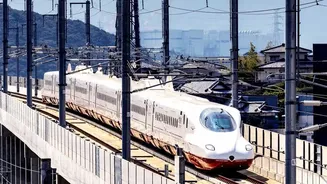
A trial run is far more than just putting a train on the tracks and seeing how fast it goes. It is a meticulous process designed to validate every single component of the new high-speed system. Engineers will test the structural integrity of the viaducts and bridges, the stability of the newly laid tracks, and the reliability of the advanced signalling and communication systems. The trainsets themselves, based on Japan's proven E5 Series Shinkansen, will undergo rigorous assessments. These tests start at low speeds and are gradually increased, allowing technicians to monitor everything from vibrations and noise levels to the performance of the automatic braking systems under real-world conditions. The entire process is about ensuring that the system meets the stringent safety and performance standards of the Japanese Shinkansen, which famously has a zero-fatality record from accidents. This phase is critical for ironing out any issues before the line is certified safe for public use.
The Shinkansen Edge
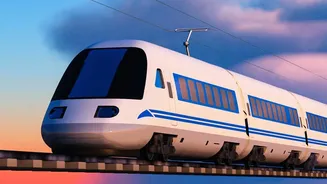
The decision to use Japanese Shinkansen technology for India's first bullet train was a deliberate one. The E5 series trains are engineered for an operational speed of 320 km/h and are renowned for their safety, efficiency, and passenger comfort. A key feature is their aerodynamic design, including a long nose that helps prevent the loud 'tunnel boom' phenomenon when entering tunnels at high speed. The trains are also equipped with advanced safety features like automatic braking systems and anti-derailment mechanisms. For passengers, the experience will be a world away from conventional rail. The coaches are designed to be spacious and quiet, with rotating seats and modern amenities. The project involves not just importing trains but also significant technology transfer, with a portion of the fleet set to be manufactured in India under the 'Make in India' initiative.
Challenges and Progress on the Ground
Executing a project of this magnitude has not been without its challenges. Initial delays were caused by issues with land acquisition, particularly in Maharashtra, and the global pandemic. However, recent updates from the National High Speed Rail Corporation Limited (NHSRCL), the agency executing the project, show that work is advancing rapidly. As of mid-2026, a significant portion of the elevated viaducts and piers have been completed, especially in the Gujarat section. All land required for the project has been acquired, and work is progressing on all 12 stations along the route. Construction is being done in phases, with the Surat-Bilimora section expected to be among the first to become operational. This phased approach allows parts of the corridor to open to the public even as work continues on more complex sections, like the 21-km undersea tunnel near Mumbai.
The Bigger Picture for a New India
The Mumbai-Ahmedabad corridor is envisioned as the first artery in a much larger network of high-speed rail lines connecting major cities across the country. The government has already proposed seven additional corridors, including routes like Delhi-Varanasi and Mumbai-Nagpur. The successful implementation of this first project is expected to create a standardised template for future high-speed development, making subsequent projects faster and more cost-effective. Beyond simply cutting travel time between Mumbai and Ahmedabad to about two hours, the bullet train is expected to spur significant economic growth along the corridor, creating jobs, boosting industrial development, and improving connectivity between key economic hubs. The 2027 trial run is therefore more than just a test; it's the first tangible glimpse of a future where India runs on high-speed tracks.