





A Landmark Orbital Mission
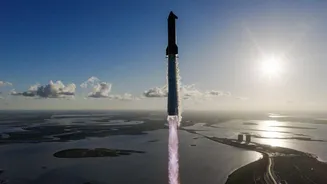
On September 28, 2026, SpaceX's Starship, the world's largest rocket, successfully launched from Starbase, Texas, and achieved Earth orbit for the first time. This was the 14th test flight for the program, but the first to be deliberately placed on an orbital
path. During the mission, the spacecraft’s upper stage, known as Ship, successfully deployed 26 of SpaceX’s next-generation Starlink V3 satellites into low-Earth orbit. The deployment mechanism, which works like a Pez dispenser, released the satellites one by one at an altitude of approximately 270 kilometres. Although the mission was shortened from a planned ten hours to about three as a precaution following a minor engine issue during ascent, it successfully achieved its primary goals. The flight marked a significant transition for the Starship program, moving from experimental tests toward operational use.
Powering the Next-Generation Starlink
The successful deployment is a crucial milestone for SpaceX's Starlink internet constellation. The 26 satellites are the new V3 models, which are significantly larger and more powerful than their predecessors. In fact, they are too large to launch on SpaceX's workhorse Falcon 9 rocket, making Starship essential for building out the advanced network. Each V3 satellite is designed to support vastly increased data capacity, with SpaceX noting that a full Starship launch of 60 V3 satellites could deploy 20 times the capacity of a Falcon 9 mission. This launch was the first time Starship placed operational satellites into the constellation that will remain in service. An earlier suborbital flight in July had deployed V3 satellites, but they were designed to re-enter the atmosphere shortly after. With this successful mission, Starship has proven it is the key to unlocking the full potential of the global internet service.
Why NASA is Watching So Closely
Beyond its own commercial goals with Starlink, SpaceX's progress is being intensely monitored by NASA. The U.S. space agency is relying on a modified version of Starship to serve as the Human Landing System (HLS) for its Artemis program, which aims to return astronauts to the lunar surface. Under the current plan, astronauts will launch in NASA's Orion capsule, then rendezvous and dock with a Starship lander in lunar orbit for the final descent to the Moon. Therefore, every Starship flight, especially an orbital one, provides crucial data on the vehicle's performance and reliability. NASA needs Starship to be a proven and safe platform before it can be trusted with astronauts. This orbital mission, despite the early engine shutdown, demonstrated the vehicle's robustness and ability to complete its primary objectives, a key confidence-builder for the Artemis program.
The Path to Reusability and the Moon
While reaching orbit and deploying satellites were the main successes, the mission also provided valuable data for SpaceX's ultimate goal: creating a fully and rapidly reusable launch system. The Super Heavy booster successfully performed its boostback burn and made a controlled splashdown in the Gulf of Mexico. The Starship upper stage also completed its journey with a splashdown in the Pacific Ocean. The long-term vision is for both stages to return to the launch site and be caught by mechanical arms, allowing for rapid reuse and drastically lower launch costs. For NASA's lunar missions, this reusability is part of a broader, more complex plan that includes in-space refueling. To get to the Moon, the Starship lander will need to be fully fueled in Earth orbit by a series of 'tanker' Starship flights. This successful orbital mission is a foundational step toward demonstrating the capabilities needed for those future, more ambitious operations.