






An Inevitable Collision
On August 5, 2026, a four-tonne piece of space junk concluded its year-long journey through the cosmos with a violent, silent crash. The object was the upper stage of a SpaceX Falcon 9 rocket, left over from a mission in January 2025 that successfully
delivered two lunar landers into space. Unlike the reusable first-stage boosters that famously return to Earth, this second stage was left in a chaotic, high orbit. For over a year, the gravitational pulls of the Earth, Moon, and Sun played a slow-motion game of billiards with the derelict rocket body. Astronomers tracked its path, predicting its eventual fate with startling accuracy. The impact was unavoidable, a direct consequence of leaving hardware adrift in an unpredictable environment. Travelling at an estimated 5,400 miles per hour, the 46-foot-long object slammed into the Moon with the force of nearly three tons of TNT.
The Hunt for the Scar
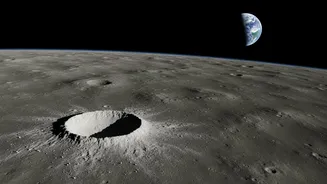
Confirming a crash on a celestial body 239,000 miles away is no simple task. The impact itself was not directly imaged as it happened, but its effects were. Telescopes on Earth, like the Very Large Telescope in Chile, detected a faint plume of gas rising from the lunar surface moments after the predicted collision. By analysing the light, scientists identified signatures of lithium from the rocket's batteries and sodium from the vaporised moon dust, providing the first evidence of the event. Shortly after, South Korea’s Danuri lunar orbiter captured the definitive proof: before-and-after photos of the impact site near the large Einstein Crater. The images revealed a new pockmark estimated to be up to 100 feet wide and 16 feet deep. The headline-making claim that the crater is “visible from lunar orbit” is true for any feature of this size when viewed by a dedicated spacecraft, and Danuri provided the crucial orbital perspective to confirm its existence.
An Accidental Science Experiment
While SpaceX did not intend for its rocket to become a lunar impactor, the event provided a rare opportunity for scientific study. Crashes like this are essentially unplanned experiments in impact physics. By observing the size and shape of the crater and the composition of the ejected plume, researchers can refine their models of how impacts occur on airless bodies. This unplanned crash serves as a real-world data point, complementing previous intentional impacts, like those from the Apollo program's S-IVB stages. Those impacts helped seismologists study the Moon's interior. This new crater, created by a modern and well-documented piece of hardware, offers fresh insights for a new generation of lunar scientists. It helps them understand the properties of the lunar surface and how man-made objects behave upon high-velocity impact, data that could be valuable for designing future lunar habitats and equipment.
A Growing Junkyard in the Sky
This Falcon 9 stage is far from the first man-made object to hit the Moon. However, its story highlights a critical and escalating issue: space debris. For decades, the space around Earth and beyond has been accumulating spent rocket stages, defunct satellites, and fragments from collisions. Russia, the United States, and China are the primary contributors to the tens of thousands of trackable objects in orbit. While many pieces of debris are in Earth orbit, threatening active satellites and the International Space Station, this lunar impact brings the problem to another world. It represents a new era where the actions of commercial companies, not just national space agencies, have permanent consequences on other celestial bodies. As the number of launches per year continues to rise, driven by commercial interests like satellite internet constellations, the challenge of managing this orbital junkyard grows more urgent.
The Question of Responsibility
So, who is responsible for a rocket that crashes into the Moon? According to international agreements like the 1972 Liability Convention, the “launching state”—in this case, the United States—bears international responsibility for any damage caused by its space objects. This applies whether the launch was conducted by a government agency like NASA or a private company like SpaceX. However, the framework is old and doesn't fully address the complexities of a crowded space environment filled with commercial actors. There is no international body for space traffic control, and no one is tasked with actively cleaning up debris. This impact is a clear signal that as humanity expands its presence with missions like Artemis and commercial lunar bases, the existing rules and norms for space conduct need to evolve. The conversation is shifting from simply tracking debris to actively managing it and designing future missions with responsible disposal plans from the outset.