






The Sun's Mysterious Silence
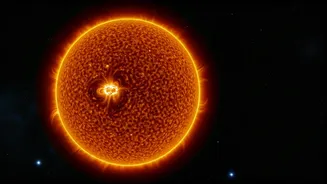
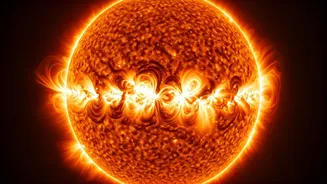
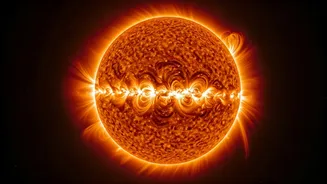
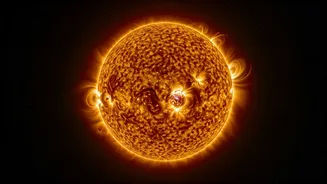
Between approximately 1645 and 1715, astronomers noticed something unsettling: the Sun’s face was nearly blank. The dark blemishes known as sunspots, which typically appear and fade in a predictable 11-year cycle, had become exceedingly rare. This period
of intense solar inactivity became known as the Maunder Minimum. Adding to the mystery, this solar silence coincided with the coldest part of the “Little Ice Age,” a period of significant cooling in Europe and North America. Scientists have long puzzled over what caused the Sun’s internal dynamo to falter so dramatically. A key question was whether the Sun’s activity sputtered out erratically or if it transitioned into this quiet state from a normal rhythm. The data was simply too sparse to be certain.
An Accidental Clue from a Giant
The crucial clue didn’t come from a state-of-the-art satellite, but from a forgotten drawing made decades before the Maunder Minimum even began. In May 1607, the brilliant German astronomer Johannes Kepler, renowned for his laws of planetary motion, pointed a device called a camera obscura at the Sun. This instrument, which projects an image through a small pinhole, was a safe way to view the star before the invention of filtered telescopes. Kepler noticed a dark spot on the projected image and, logically but incorrectly, assumed he was witnessing the planet Mercury transiting across the solar disc. He made detailed sketches of what he saw. In reality, he had drawn one of the earliest documented images of a large sunspot group. For centuries, this observation was treated more as a historical curiosity than a piece of hard data.
Connecting a 400-Year-Old Dot
A recent study led by researcher Hisashi Hayakawa of Nagoya University revisited Kepler's work. The team realised these pre-telescopic drawings held a vital piece of information: the sunspot's location. By carefully recreating the viewing conditions and analysing Kepler's notes, they determined the position of the sunspot on the solar surface. They found it was located at a low solar latitude, close to the Sun’s equator. This was the breakthrough. According to a principle known as Spörer’s Law, new solar cycles begin with sunspots appearing at high latitudes near the poles, and as the cycle progresses, subsequent spots form closer and closer to the equator. A spot near the equator means the solar cycle is at its end, not its beginning.
A Normal Rhythm Before the Calm
This single data point from 1607 dramatically changes the picture. Previous reconstructions, some based on carbon-14 levels in tree rings, had suggested that the cycles leading into the Maunder Minimum might have been highly irregular, with one theory proposing an extremely short cycle followed by an extremely long one. Kepler’s drawing refutes this. By placing a sunspot at the end of a cycle in 1607, it shows that the Sun was behaving normally just a few years before the first telescopic observations began. The transition from that cycle to the next appears to have been smooth and followed a standard duration. This implies the Sun didn't lurch or sputter into its 70-year hibernation. Instead, it seems to have slipped into the grand minimum from a state of regular, predictable activity.
Why Old Blunders Still Matter
Understanding the lead-up to the Maunder Minimum is crucial for modelling long-term solar behaviour and its potential effects on Earth’s climate and space weather. Kepler’s observation helps anchor the timeline of solar activity and refines the scientific models used to understand our star’s past and future. It stands as a powerful testament to the enduring value of meticulous observation. Kepler had no idea he was recording data that would help solve a solar mystery four centuries later; he was simply documenting what he saw. His accidental sketch of a sunspot, a minor blunder in an illustrious career, has provided the missing link that modern scientists needed, proving that sometimes the oldest data can shed the brightest light on today’s biggest questions.