



A Celestial Snapshot
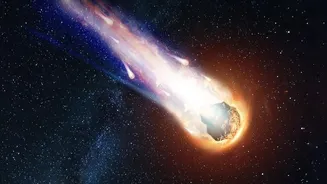
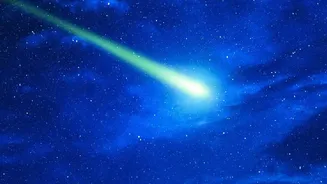
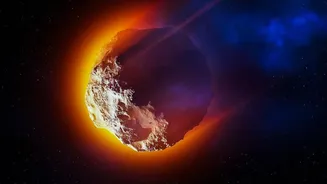
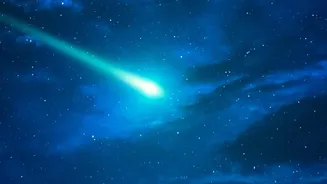
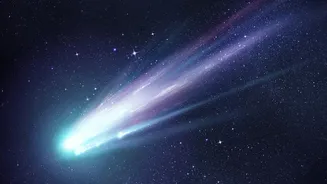
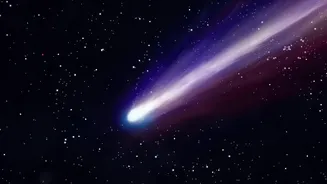
Every day, Earth is bombarded by tons of material from space. Most of these particles, often no bigger than a grain of sand, burn up harmlessly high in our atmosphere, creating the fleeting streaks of light we call meteors or shooting stars. A recent
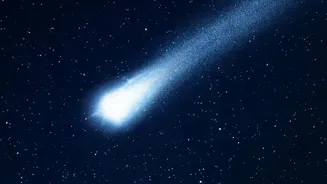
image, highlighted by NASA, captured one such event with spectacular clarity. The photograph shows a bright meteor vaporizing as it enters the atmosphere, leaving behind a glowing trail. While a beautiful sight, the real scientific value lies in what is left behind: a trail of vaporized elements and microscopic dust that gives scientists a unique window into the upper reaches of our sky.
More Than Just Cosmic Dust
When a meteoroid, the term for the object before it hits our atmosphere, burns up, it creates a trail of ionized gas and tiny particles known as 'meteoric smoke'. For years, scientists have studied this phenomenon. NASA can even collect some of this cosmic dust using high-altitude aircraft for laboratory analysis. This 'smoke' is composed of particles often just nanometers in size, one-thousandth the width of a human hair. These particles linger high in the mesosphere, between 60 and 90 kilometres up, for long periods. Previously difficult to study, modern tools like NASA’s Solar Occultation for Ice Experiment (SOFIE) have allowed researchers to analyse the composition and distribution of this meteoric smoke with unprecedented detail.
The Atmospheric Connection
So, how does dust from space rocks relate to atmospheric heating? These tiny particles of meteoric smoke play a surprisingly large role in the chemistry and dynamics of our upper atmosphere. They act as nucleation sites, tiny seeds around which water molecules can gather to form ice crystals. This process is fundamental to the formation of noctilucent, or 'night-shining', clouds, which are the highest clouds in Earth's atmosphere. Studies have found that about 3% of each ice crystal in these clouds is made of meteoritic material. These clouds, and the smoke particles themselves, can absorb or scatter sunlight, influencing the energy balance of the atmosphere. By studying how much solar radiation is blocked or reflected, scientists can better model how this region of the atmosphere heats and cools.
A New Tool for Climate Science
Tracking atmospheric temperature is a critical part of climate science, but studying the high-altitude mesosphere is notoriously difficult. It’s too high for weather balloons and too low for most satellites. This is where meteors become invaluable. The trails of ionized plasma and smoke they leave behind can be tracked with ground-based radar. As the upper-level winds blow these trails around, scientists can measure the wind speed and direction at these extreme altitudes. Furthermore, by analysing how the dust disperses and its effect on cloud formation, researchers gain another data point for their climate models. Each new image and data set from a meteor provides another piece of the puzzle, helping to refine our understanding of atmospheric dynamics and how they are responding to a changing climate.
What This Means For Our Planet
The increasing focus on meteoric smoke is part of a broader effort to understand all the variables that affect our climate. While industrial emissions and greenhouse gases are the primary drivers of warming in the lower atmosphere, the upper atmosphere has its own complex system of heating and cooling. The dust from tens of tons of cosmic material that falls to Earth each day is a natural part of that system. By better understanding the role these particles play, from seeding clouds to influencing the atmospheric energy budget, scientists can build more accurate and comprehensive climate models. This allows for better predictions and a clearer picture of the changes happening to our planet. It’s a powerful reminder that sometimes, to understand what’s happening on Earth, we need to look to the stars.