









What Is Project Suncatcher?
Project Suncatcher is a long-term research initiative from Google aimed at exploring the feasibility of hosting large-scale machine learning infrastructure in space. Announced in 2025, the core idea is to move the energy-intensive work of AI computing
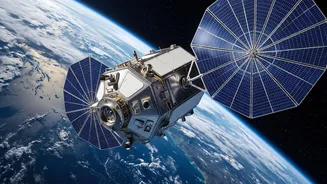
off-planet. The project envisions a future where constellations of interconnected satellites, equipped with Google's custom Tensor Processing Units (TPUs), could form orbiting data centres. This first in-orbit test, launching on a SpaceX Transporter-18 rideshare mission, is not about creating a functional data centre yet. Instead, it's a fundamental experiment to answer a basic but critical question: can Google's AI hardware actually survive and operate in the harsh environment of space?
Why Put Data Centres in Space?
The primary motivation is power. AI is notoriously power-hungry, and the demand for electricity to run data centres on Earth is growing exponentially. Project Suncatcher proposes a solution by tapping into the most powerful source in our solar system: the sun. In low Earth orbit, solar panels can receive near-constant sunlight, free from weather or atmospheric interference. Google estimates that a solar panel in orbit can be up to eight times more productive than one on Earth. By moving AI computation to space, companies could reduce the immense strain on terrestrial power grids and sidestep land and water usage issues that plague ground-based facilities. It's a concept being explored not just by Google, but by other major players like SpaceX and Starcloud as well.
The Challenges of an Orbital Test
Sending sensitive electronics into space is a formidable engineering challenge. This first prototype satellite, developed with Planet Labs and roughly the size of a refrigerator, will test how four of Google's TPUs handle the extreme conditions. The journey to orbit alone involves intense vibrations and forces up to 10 times stronger than Earth's gravity. Once there, the chips face a barrage of cosmic radiation that can cause data errors known as 'bit flips'. Google has already conducted ground-based testing, including exposing chips to proton beams and shaking them on vibration tables, with promising results. Another major hurdle is cooling. Without air, conventional fans are useless. The prototype will use a system of heat pipes and radiators to manage the intense heat the chips generate, though it can only run them in 15-minute bursts before needing to cool down.
From 'Eyes' to 'Brains' in the Sky
This test signals a broader shift in satellite technology. For decades, satellites have acted primarily as 'eyes in the sky,' capturing vast amounts of raw data and beaming it back to Earth for processing. This creates a significant bottleneck, limiting how quickly insights can be derived. By placing AI chips directly on satellites—a concept known as on-orbit or edge processing—the satellites themselves can analyse data in real-time. Instead of sending down terabytes of raw imagery, a satellite could identify a wildfire or a flood and transmit only the critical, actionable information. This dramatically reduces data downlink requirements and enables much faster responses to time-sensitive events, from disaster management to defence applications.
What's Next for Suncatcher?
This initial launch is all about gathering data and learning from potential failures. It’s the first of many steps. Google already has plans for 2027, which include launching two more satellites to test another critical piece of the puzzle: high-bandwidth laser communication. For an orbiting data centre to work, individual satellites will need to talk to each other, forming a seamless, interconnected network. These high-speed lasers are envisioned as the data-carrying backbone of a future satellite constellation. While the commercial viability of orbital AI infrastructure remains years away, this test represents a significant milestone. It's a calculated gamble on a new architecture for computing as the demand for AI power continues to soar on Earth.