



A Defining Cosmic Smash-Up
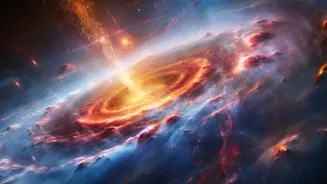
Long before our Sun was born, the young Milky Way was on a collision course. Around 10 billion years ago, it smashed head-on into a massive dwarf galaxy. Astronomers have nicknamed the doomed intruder Gaia-Enceladus, or more playfully, the “Gaia Sausage,”
because of the elongated, sausage-like orbits its remnant stars now follow. This wasn't a minor fender-bender; it was the last major merger in our galaxy's history and its single most defining event. The invading galaxy, which had a mass of over 10 billion Suns, was torn to shreds. Its stars, gas, and dark matter were violently scattered and absorbed into the growing Milky Way.
More Than Just New Stars
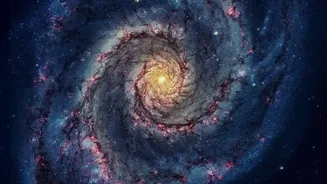
For years, the primary evidence of this ancient merger was found in the galaxy's 'stellar halo'—a sparse, spherical cloud of old stars surrounding the main galactic disk. Many of these halo stars have unique chemical compositions and movements that mark them as immigrants from the Gaia Sausage galaxy. This collision was known to have populated the halo and created the bulge at the galaxy's center. But the story doesn't end there. Scientists are now realizing the impact of this cosmic crash was far more disruptive, with consequences that rippled through the very structure of the Milky Way's main disk—the part of the galaxy we call home.
Reshaping the Galactic Disk
The collision's debris didn't just settle politely in the halo. The impact caused immense disruption, puffing up what was likely a thin, primordial disk of stars. This event effectively created what astronomers now call the Milky Way's 'thick disk,' a structure twice as thick as the 'thin disk' where younger stars like our Sun reside. The force of the impact triggered waves of star formation and may have fractured the original disk entirely, forcing the Milky Way to regrow a new one over time. Essentially, the galaxy we see today was fundamentally remodeled by the wreckage of this ancient merger.
Did Our Entire Galaxy Flip Over?
The changes might have been even more dramatic. Recent simulations presented in July 2026 suggest the collision could have caused the entire galactic disk to flip its orientation by more than 90 degrees. This incredible 'disc flip' theory helps explain a long-standing mystery: why the stars in the Milky Way's halo rotate so slowly compared to the disk. According to researchers, galaxies that experience both a major head-on collision and a subsequent flip end up with slow-moving halos just like ours. This suggests the violent encounter with Gaia Sausage may have sent our entire galaxy into a slow, cosmic tumble that reoriented it completely.
Our Cosmic Origin Story
Understanding this ancient event is about more than just galactic history; it's about understanding our own origins. The chemical makeup of stars provides clues to their birthplace. The collision stirred the galactic pot, mixing gas and triggering bursts of star formation that changed the chemical evolution of the Milky Way. The material from the Gaia Sausage galaxy, enriched with heavier elements from its own life cycle, seeded our galaxy with new raw materials. This reshuffling of cosmic ingredients ultimately contributed to the conditions that, billions of years later, allowed for the formation of stars like our Sun and planets like Earth.