



Our Solar System's Cosmic Shield
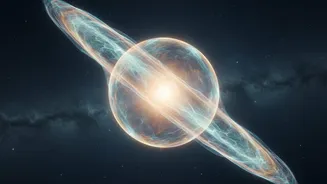
Imagine the Sun not just as a source of light and heat, but as the engine of a colossal bubble. This bubble, known as the heliosphere, is created by the constant outflow of charged particles from the Sun, called the solar wind. This wind travels billions
of kilometres in every direction, pushing back against the material that drifts between the stars, known as the interstellar medium. The edge of this bubble, the heliopause, is the boundary where the Sun's influence ends and interstellar space truly begins. This shield is vital, as it deflects a significant amount of high-energy cosmic rays that would otherwise bombard the planets, including Earth. For decades, our only direct measurements from this boundary came from the Voyager spacecraft, which crossed it after decades of travel. But understanding its overall shape and dynamics has remained a profound challenge.
Meet the New Celestial Cartographer
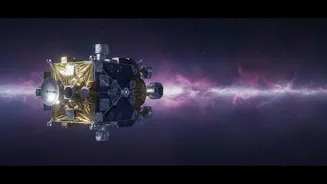
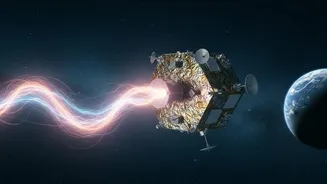
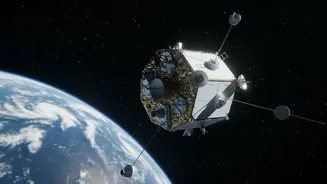
Enter NASA's Interstellar Mapping and Acceleration Probe, or IMAP. Launched in September 2025, this state-of-the-art observatory is a modern-day celestial cartographer designed specifically to map this invisible boundary. Stationed about 1.5 million kilometres from Earth in the direction of the Sun, IMAP has a unique vantage point. It is equipped with a suite of ten advanced instruments, each designed to sample and analyze the cosmic particles that flow past it. On August 7, 2026, NASA and its partners at Princeton University made the first major batch of this scientific data public, opening a new chapter in our understanding of the solar system's home in the galaxy.
How to Map an Invisible Frontier
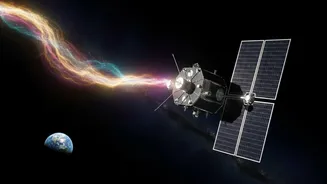
So how do you map a boundary that is not only invisible but also billions of kilometres away? IMAP uses a clever technique that is a significant upgrade from its predecessor, the IBEX mission. When the fast-moving particles of the solar wind collide with the slow, cold particles of the interstellar medium at the heliosphere's edge, some of them exchange charges. This process creates what are known as Energetic Neutral Atoms (ENAs). Unlike the charged particles they came from, these ENAs are not affected by magnetic fields. They travel in straight lines from the point of collision. By detecting these ENAs as they arrive at its location, IMAP can trace their paths back to their origin, effectively creating a map of the distant boundary. It's like using sonar, but instead of sound waves, IMAP uses these atomic messengers to 'see' the structure of the heliosheath, the turbulent outer region of our solar system.
First Postcards from the Edge
The recently released data, collected over the first few months of the mission's science operations which began in February 2026, comes from seven of IMAP’s ten instruments. This initial trove includes measurements of the solar wind, interstellar dust particles, and the composition of various ions. While scientists are just beginning to analyze this information, it represents a foundational dataset for building the most detailed maps of the heliosphere ever created. Every six months, IMAP will complete a scan of the entire sky, allowing researchers to create successive maps that will show not just the boundary's structure, but how it changes and breathes in response to the Sun's activity and our journey through the galaxy. This data is critical for testing and refining the physics models that have, until now, only theorized about this complex interaction.
From Pure Science to Practical Protection
Understanding the heliosphere is not just an academic exercise. The same solar wind that creates our protective bubble also poses a threat to technology and astronauts. Violent solar events can send floods of dangerous radiation toward Earth. A key part of IMAP's mission is to act as an advanced space weather sentinel. Through its IMAP Active Link for Real-Time (I-ALiRT) system, it continuously broadcasts data on the solar wind heading our way, providing forecasters with crucial information to issue warnings for satellites, power grids, and especially for human spaceflight missions like Artemis. This real-time data can provide a vital heads-up for astronauts and mission controllers, making deep space exploration safer.