



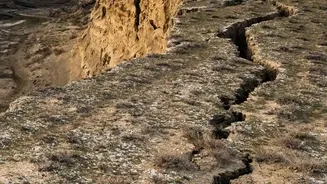
1. The 1991 Uttarkashi Earthquake
On October 20, 1991, a magnitude 6.8 earthquake struck the Garhwal region of Uttarakhand, leaving over 768 people dead and destroying tens of thousands of homes. This was one of the first major quakes in the newly independent India's memory to highlight
the specific seismic vulnerability of the Himalayas. The event was a harsh lesson in engineering, revealing that traditional stone masonry houses, especially those with heavy slate roofs, were death traps. It redefined risk by shifting the focus to building codes and the need for earthquake-resistant construction techniques, a conversation that had previously been academic but was now a matter of life and death. The disaster exposed major gaps in relief operations, which were hampered by landslides and damaged roads, underscoring the need for a more robust disaster response strategy in inaccessible mountain terrain.
2. The 2005 Kashmir Earthquake
Striking on October 8, 2005, this magnitude 7.6 earthquake was a transnational catastrophe, causing devastation across Pakistan-administered Kashmir and parts of Jammu and Kashmir. With a death toll exceeding 75,000, it laid bare the sheer scale of destruction a major Himalayan earthquake could unleash. Before this, disaster planning was often localised. The Kashmir quake redefined risk by demonstrating that Himalayan disasters do not respect borders and require large-scale, coordinated national and international responses. It revealed significant weaknesses in communication networks and coordination among government and non-government agencies during relief efforts. The tragedy forced a systemic rethink, leading to the creation of more formalised disaster management authorities and highlighting the critical need for pre-disaster preparedness plans, which were largely absent before.
3. The 2013 Kedarnath Floods
Often called the 'Himalayan Tsunami', the June 2013 disaster in Uttarakhand was a watershed moment. Triggered by extreme rainfall and a glacial lake outburst flood (GLOF), it caused thousands of deaths and unimaginable destruction. This event fundamentally redefined risk by shifting the focus from just earthquakes to the terrifying power of hydro-meteorological disasters. It brutally exposed how unchecked and unplanned development—roads, hotels, and hydropower projects—in ecologically sensitive zones dramatically multiplies the impact of a natural hazard. The tragedy forced authorities to confront the concept of 'carrying capacity' in pilgrimage sites and led to one of the largest air rescue operations in history, known as Operation Surya Hope. Post-2013, disaster management strategies began to incorporate climate change impacts and the dangers of rampant construction more seriously.
4. The 2015 Nepal Earthquake
Although its epicentre was in Nepal, the magnitude 7.8 earthquake of April 2015 sent shockwaves—both literal and figurative—across India. It served as a live, televised dress rehearsal for what a major seismic event could do in a densely populated Himalayan region. The disaster, which prompted India to launch its largest-ever disaster relief operation, 'Operation Maitri', redefined risk perception for millions of Indians. The widespread images of collapsed buildings in Kathmandu brought the importance of structural safety and retrofitting into urban Indian homes. It highlighted India's role as a first responder in regional crises but also pointed to the need for better coordination mechanisms for international aid. The event spurred a renewed push for seismic safety assessments and public awareness campaigns across the Indian Himalayas.
5. The 2021 Chamoli Flash Flood
On February 7, 2021, a massive flood tore through the Rishiganga and Dhauliganga valleys in Uttarakhand, washing away two hydropower projects and killing over 200 people. Initially suspected to be a GLOF, investigations later confirmed it was caused by a colossal rock and ice avalanche from Ronti Peak. This event redefined Himalayan risk by introducing a new, terrifying variable directly linked to climate change: the instability of high-altitude rock and glaciers. It showed that a disaster could be triggered without a glacial lake or extreme rain, but simply by a massive landslide of ice and rock from a warming mountain slope. The Chamoli disaster put a harsh spotlight on the vulnerability of hydropower infrastructure in the upper Himalayas and forced scientists and policymakers to consider cascading hazards, where one failure triggers another.
6. The 2023 Joshimath Land Subsidence
Unlike the sudden violence of a flood or earthquake, the crisis in Joshimath was a slow-motion disaster. In early 2023, large cracks began appearing in hundreds of buildings and roads as the ground beneath the town began to sink. This event redefined risk as not just a sudden catastrophe but also a gradual, man-made degradation. Joshimath is built on ancient landslide debris, a fact known for decades. The subsidence was attributed to decades of unplanned construction, the absence of a proper drainage system, and the potential impact of nearby infrastructure projects like the Tapovan Vishnugad hydropower project. It served as a stark warning about exceeding the 'carrying capacity' of fragile mountain towns and demonstrated that ignoring geological realities in the pursuit of development creates its own inevitable disaster.
7. The 2026 Nepal-Tibet Flash Flood
In late August 2026, a catastrophic flash flood originating near the Nepal-Tibet border caused widespread devastation, with its impacts felt downstream in India. The event was a chilling reminder of the cascading nature of Himalayan disasters, likely caused by a rock-ice avalanche that created a temporary dam, leading to a massive outburst flood. This moment redefined risk by powerfully illustrating that a disaster in a neighbouring country can become a direct threat to India due to shared river basins. It moved the conversation beyond just national preparedness to the urgent need for transboundary early warning systems and basin-wide risk management. The disaster underscored that in the interconnected Himalayan river systems, disaster risk governance cannot operate in isolation.