




A New Eye on the Cosmos
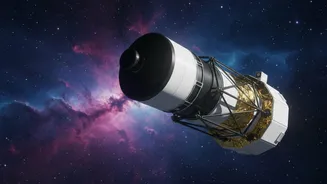
Poised to join the legendary ranks of the Hubble and James Webb space telescopes, the Nancy Grace Roman Space Telescope is an infrared observatory with a very specific and powerful advantage. Scheduled to lift off from the Kennedy Space Center aboard
a SpaceX Falcon Heavy rocket, Roman represents a new era in space-based astronomy. Named after Nancy Grace Roman, NASA’s first chief of astronomy, the mission has been developed with a clear focus on efficiency and scope. After its launch, it will travel for months to its operational orbit at the second Lagrange point (L2), a gravitationally stable spot about 1.5 million kilometres from Earth, where it will begin its ambitious decade-long survey of the heavens. The mission is not just another telescope; it's a cosmic data-gathering machine designed to tackle some of the biggest questions in astronomy today.
Unravelling a Dark Universe
One of Roman’s two primary objectives is to address one of the most profound puzzles in physics: the nature of dark energy. This mysterious force is believed to be responsible for the accelerating expansion of the universe. To investigate it, Roman will conduct massive surveys, capturing images of over a billion galaxies to map their distribution across cosmic time. By studying how clusters of galaxies are spread out and how their light is distorted by the gravity of unseen matter (a phenomenon known as weak gravitational lensing), scientists can trace the history of cosmic expansion with unprecedented precision. Roman is not necessarily designed to tell us what dark energy is, but to measure its effects so accurately that it will provide crucial data to test competing theories. This survey of the large-scale structure of the cosmos will give us the most detailed 3D map of the universe ever created.
The Hunt for a Thousand New Worlds
While one instrument looks deep into cosmic history, the other will focus on the search for exoplanets within our own Milky Way galaxy. The Roman Space Telescope will use a powerful technique called gravitational microlensing. This occurs when a massive object, like a star, passes in front of a more distant star, briefly magnifying its light. If the foreground star has planets, they create their own smaller magnification spikes, revealing their presence, mass, and distance from their star. This method is sensitive enough to find planets much less massive than Earth. In addition to this survey, Roman is equipped with a Coronagraph Instrument. This technology demonstrator is designed to block the overwhelming glare of a star, allowing the telescope to directly photograph the faint planets orbiting it. It's a key step toward the future goal of analyzing the atmospheres of Earth-like planets for signs of life.
Hubble's Vision, a Hundred Times Wider
What makes Roman a revolutionary tool is not the size of its mirror—at 2.4 meters, it is the same diameter as Hubble's—but the sheer scale of its vision. Its Wide Field Instrument gives it a field of view 100 times larger than that of the Hubble Space Telescope. This panoramic capability means that where Hubble would have to painstakingly stitch together thousands of images to map a large area of the sky, Roman can do it in a fraction of the time. One scientist noted that a survey of the Milky Way that would take Hubble a century to complete could be done by Roman in just a few months. This ability to conduct deep, sweeping explorations of the cosmos will generate an enormous amount of data, projected to be over 500 terabytes per year, creating a rich archive for astronomers to mine for decades to come.
Why This Mission Is a Game-Changer
The Roman Space Telescope isn’t just a successor to Hubble or a competitor to Webb; it’s a powerful complement to them. While Hubble provides stunningly deep and detailed views of small patches of sky and Webb peers back to the dawn of time in infrared, Roman will provide the wide-angle context. It will find countless new targets—from rogue planets to distant supernovae—that other telescopes can then study in more detail. Its dual focus on cosmology and exoplanets, combined with its incredible survey speed, makes it one of the most anticipated science missions of the decade. By aiming to create the largest-ever map of the universe while simultaneously taking a census of planets in our galactic backyard, Roman is poised to transform our understanding of our place in the cosmos.