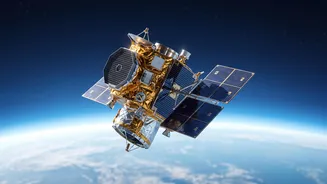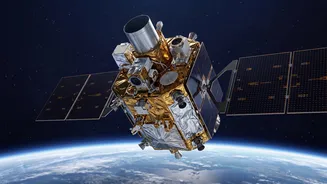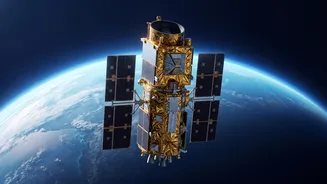




After 22 years of unlocking cosmic secrets, NASA's legendary Neil Gehrels Swift Observatory has taken its final bow. On November 4, the famed gamma-ray telescope ended its mission in a fiery streak across the skies over Indonesia.
A Final, Fiery Descent
On Wednesday, November
4, 2026, the skies over the North Sumatra region of Indonesia hosted a rare and dramatic event: the final moments of a celebrated NASA spacecraft. At approximately 7:39 a.m. EST (12:39 UTC), the U.S. Space Force confirmed that the 1,450-kilogram Swift Observatory had re-entered Earth's atmosphere. The descent marked the end of an era for the satellite, which had been in a decaying orbit for months. While NASA expected the vast majority of the observatory to burn up due to the intense heat and friction of re-entry, the agency acknowledged that some durable components might have survived the fall. Indonesian authorities were on alert, though the calculated risk of harm to anyone on the ground was deemed low, at approximately 1 in 2,100.
What Was the Swift Observatory?
Launched on November 20, 2004, the Neil Gehrels Swift Observatory was a game-changing space telescope designed for a mission of cosmic urgency. Its primary purpose was to study gamma-ray bursts (GRBs), the most powerful and energetic explosions in the universe. These events, often linked to the collapse of massive stars or the collision of neutron stars, are incredibly bright but fleeting. Swift's revolutionary design allowed it to live up to its name; upon detecting a new GRB with its Burst Alert Telescope, it could autonomously pivot its other instruments—an X-Ray Telescope and an Ultraviolet/Optical Telescope—to the source in under a minute. This rapid-response capability allowed scientists, for the first time, to study the afterglow of these distant cataclysms in detail, providing invaluable data to observatories around the world.
A Legacy Far Beyond Its Lifespan
Originally designed for a two-year mission, Swift exceeded all expectations, operating for nearly 22 years. During its two decades of service, the observatory became an indispensable multi-tool for astronomers. It detected over 2,000 gamma-ray bursts and observed more than 1,400 supernovae, contributing to roughly 7,000 scientific papers. Its observations weren't limited to the deep cosmos; Swift also studied a wide range of phenomena, from flaring stars and supermassive black holes to comets and asteroids within our own solar system. In 2018, NASA renamed the mission in honour of its first principal investigator, Neil Gehrels, who passed away in 2017, cementing its status as a cornerstone of modern astrophysics.
Why Did Swift Fall?
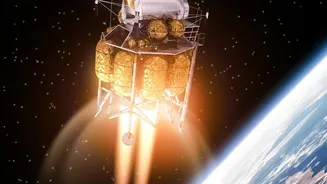
Like all satellites in low_Earth orbit, Swift was subject to faint but constant atmospheric drag. This effect was recently amplified by increased solar activity, which caused Earth's upper atmosphere to expand, quickening the satellite's orbital decay. Without its own propulsion system to boost its altitude, Swift's fate was sealed. In 2025, NASA contracted a private company, Katalyst Space Technologies, for a daring $30 million rescue mission. The plan was for a robotic servicing vehicle called LINK to grab Swift and push it into a higher, more stable orbit. However, the LINK spacecraft suffered an attitude_control malfunction after its launch in July 2026 and the rescue was called off, leaving Swift to continue its inevitable descent.
The Final Chapter
With no hope of a re_boost, NASA and its mission partners at Pennsylvania State University prepared for the end. To slow the descent after the failed rescue, science operations were briefly paused, but they resumed to gather as much data as possible in the final weeks. On October 20, 2026, after its orbit had dropped to just 275 kilometres, the spacecraft could no longer compensate for the atmospheric drag and entered a 'safe mode'. A final command was sent to officially end its operations, preparing it for its uncontrolled but closely monitored return to Earth.