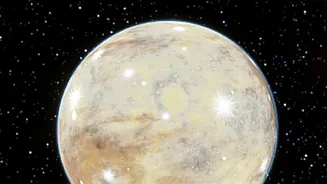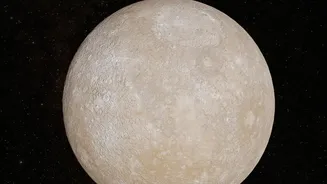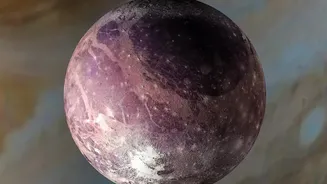


A Tale of Two Worlds
Let's start with the numbers. Ganymede has a diameter of about 5,268 kilometres, making it roughly 8% wider than Mercury, which measures about 4,880 kilometres across. If size were the only factor, you'd expect Ganymede to be a heavyweight champion. However,
when it comes to mass, Mercury is the clear winner. Ganymede has only about 45% of Mercury's mass, meaning the smallest planet in our solar system is more than twice as heavy as Jupiter's giant moon. This isn't just a small difference; it's a fundamental gap that points to two very different celestial bodies.
It's All About Density
The key to this cosmic puzzle is density. Think of it like holding a large pillow in one arm and a small dumbbell in the other. The pillow is bigger, but the dumbbell is much heavier because its material is more tightly packed. The same principle applies here. Mercury is incredibly dense, with a density of about 5.43 grams per cubic centimetre. In contrast, Ganymede is a lightweight, with an average density of just 1.94 grams per cubic centimetre. This massive difference in density is what allows the smaller Mercury to vastly outweigh the larger Ganymede. So, the real question is: what are they made of?
Inside Ganymede: A World of Rock and Ice
Ganymede is essentially a giant ball of rock and ice in roughly equal measure. It formed in the cold, outer regions of the solar system, where water ice was an abundant building material. Scientists believe that beneath its frozen, cratered crust lies a vast, saltwater ocean, which may contain more water than all of Earth's oceans combined. Below that is a rocky mantle and a metallic core. While it has a solid core, the huge proportion of water ice—which is much less dense than rock and metal—brings its overall average density way down.
Inside Mercury: The Iron Planet
Mercury, on the other hand, tells a completely different story. It formed much closer to the Sun, in a region so hot that lighter materials like water ice couldn't survive. Only heavy, rocky, and metallic elements could condense into a planetary body. The result is that Mercury is the most iron-rich planet in the solar system. It has a gigantic metallic core that is thought to make up over 40% of its entire volume. This enormous, dense core is the reason Mercury, despite its smaller size, is so incredibly massive and dense.
So, Why Isn't Ganymede a Planet?
If Ganymede is so large and complex—it even has its own magnetic field, the only moon known to do so—why is it just a moon? The modern definition of a planet has three main criteria: it must orbit the Sun, be massive enough to be pulled into a spherical shape by its own gravity, and have cleared its orbital path of other objects. Ganymede meets the second criterion easily. However, it fails the first and most fundamental test: it orbits Jupiter, not the Sun. Its classification is determined by what it orbits, not by its impressive size or planet-like features.