



A Famous Stellar Nursery
Located about 63 light-years from Earth, Beta Pictoris is one of the most studied stars in our cosmic neighbourhood. At only 23 million years old, it is a stellar infant compared to our 4.6-billion-year-old Sun. For decades, astronomers have been fascinated
by it because it is surrounded by a massive, bright disk of dust and gas — the raw material from which planets are born. This 'debris disk' makes the system a perfect natural laboratory for understanding how planetary systems like our own come into being. Before this latest discovery, scientists had already confirmed two massive gas giants, named Beta Pictoris b and c, orbiting the star.
An Unexpected Discovery
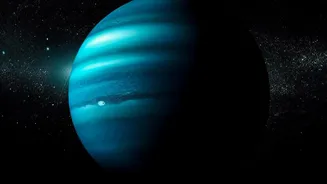
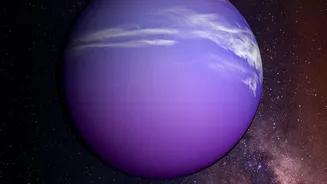
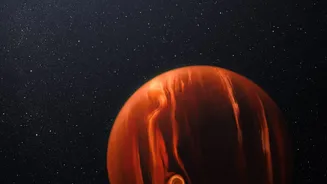
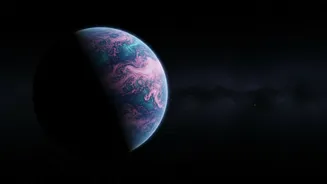
The headline-making revelation is the discovery of a third giant planet, now named Beta Pictoris d. Interestingly, the team of astronomers using the Webb telescope wasn't even looking for a new planet. They were studying the atmosphere of the already-known planet Beta Pictoris b when an unexpected signal appeared in their data. This wasn't a case of spotting a faint dot of light, which is how most planets are directly imaged. Instead, the discovery represents a powerful new technique for planet hunting. The finding was so significant that it was independently confirmed by another team using the European Southern Observatory's Very Large Telescope in Chile.
Seeing a Planet's Fingerprint
So how do you find a planet you can't see? You look for its chemical signature. The Webb telescope used its powerful NIRSpec (Near-Infrared Spectrograph) instrument, which can break down light into its component parts, much like a prism creates a rainbow. Hidden in the light from the Beta Pictoris system were tell-tale signs of a planet's atmosphere. The data showed the distinct chemical fingerprints of methane, carbon monoxide, and water vapour. This atmospheric trace was the crucial piece of evidence that a third planet was lurking within the system's bright, foggy debris disk, which had concealed it from previous searches.
The System's Hidden Architect
The existence of Beta Pictoris d solves a long-standing puzzle. For years, models of the system suggested a third large body was needed to explain certain features of the debris disk, such as its surprisingly sharp inner edge. The newly discovered planet, estimated to be at least twice the mass of Jupiter, fits the predictions almost perfectly. It orbits its star at a distance comparable to Neptune's orbit in our solar system. Astronomers believe this 'hidden architect' has been sculpting the disk around it, shaping the entire system through its gravitational influence. Finding it confirms theoretical models and deepens our understanding of the chaotic dance between planets and the disks they are born from.
A New Era of Planet Hunting
This discovery is more than just adding another exoplanet to the catalogue. It demonstrates a revolutionary way to find worlds that are otherwise impossible to detect. By using spectroscopy to identify a planet by its atmospheric composition, astronomers can now find planets buried in the glare and dust of complex environments like Beta Pictoris. It's a testament to the game-changing power of the James Webb Space Telescope. Each observation not only reveals what is out there, but provides profound new insights into the processes that formed our own solar system and could be forming Earth-like planets elsewhere in the galaxy. The story of Beta Pictoris is far from over, and Webb is just getting started.