

A Galactic Detective Story
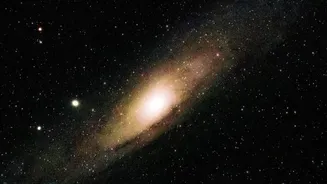
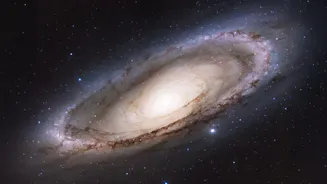
At 2.5 million light-years away, the Andromeda galaxy (M31) is the closest major spiral galaxy to our own Milky Way. This proximity makes it a unique laboratory for understanding galactic evolution. Because we are inside the Milky Way, we can't get a clear,
outside view of our own galaxy's overall structure and history. Andromeda, however, can be seen in its entirety, offering a proxy for how large spiral galaxies are built over billions of years. Astronomers have long known that Andromeda had a major burst of star formation about 2 billion years ago, likely from a galactic merger. But the question remained: what has been happening since then? The answer lies in a kind of cosmic archaeology, using individual stars as a fossil record of the galaxy's past.
Hubble's Unprecedented Star Census
To read that fossil record, astronomers turned to the Hubble Space Telescope. Using data from two extensive surveys, the Panchromatic Hubble Andromeda Treasury (PHAT) and its southern counterpart (PHAST), a team of researchers conducted an unprecedented census, mapping roughly two-thirds of the galaxy's disk and measuring around 200 million individual stars. This monumental effort was necessary because only Hubble has the sharp resolution to pick out individual stars at that distance, while also covering a vast area. By analyzing the colors of these stars—massive, young stars burn hot and blue, while older, less massive stars are redder and longer-lived—scientists could effectively rewind time and map out the history of star birth across different regions of the galaxy.
A Surprising Slowdown
The results, published in The Astrophysical Journal, revealed a galaxy that is winding down. The study found that over the last 500 million years, Andromeda's rate of star formation has been steadily declining. Around half a billion years ago, it was creating stars at a rate of about one solar mass per year, similar to the Milky Way today. But by 40 million years ago, that rate had dropped by half. Now, it has plummeted to just one-fifth of a solar mass per year. This isn't a case of the galaxy running out of gas and dust; the raw materials are still there. Instead, it appears Andromeda has entered a quieter, more quiescent phase following its hyperactive youth.
The Most Likely Suspect
So what caused this galactic slowdown? The study found the decline wasn't uniform. Much of the recent star-making activity has been concentrated in a massive ring about 32,000 light-years from the galaxy's center, and the fading of this ring is driving much of the overall decline. But astronomers also have a prime suspect for an external influence: M32, a small satellite galaxy that orbits Andromeda. The new data shows that the region of Andromeda's disk closest to M32 has an even lower rate of star formation, with a significant drop beginning around 60 million years ago. While researchers can't definitively say M32's passage through the disk is the cause—the timing doesn't perfectly match all theories—the evidence is highly suggestive. As lead author Tobin Wainer stated, "it's definitely the most likely suspect."
What This Means for the Milky Way
Understanding Andromeda's life cycle is crucial for contextualizing our own. While the two galaxies grew up in the same cosmic neighborhood, they have had very different evolutionary paths. Andromeda appears to have had a more violent past, with major mergers influencing its structure. This new data, showing a galaxy slowly settling into middle age, provides a valuable model for how galaxies like ours age and evolve. By studying our neighbor in such incredible detail, we gain a clearer picture of the forces that shape galaxies across the universe and perhaps even a glimpse into the distant future of our own Milky Way, long after its eventual collision with Andromeda billions of years from now.