



A Planet-Sized Puzzle
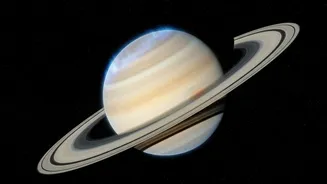
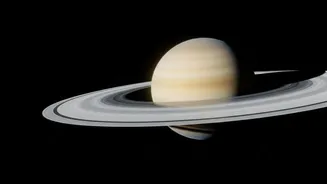
For decades, Saturn presented scientists with a confounding puzzle. Planetary magnetic fields, which act like protective shields against the harsh solar wind, are thought to be generated by the churning of liquid metal deep inside a planet. To sustain
this process, known as a dynamo, a planet's magnetic axis needs to be tilted relative to its rotational axis. Earth's is tilted by about 11 degrees. But Saturn’s magnetic field is almost perfectly aligned with its rotation. According to theory, its magnetic field shouldn't be so stable, or perhaps even exist in the way that it does. This paradox left scientists struggling to understand fundamental aspects of the ringed giant, including the true length of its day.
A Ghost in the Data
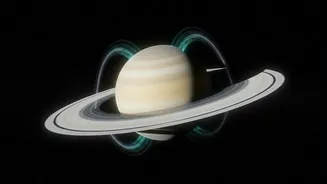
Enter Cassini. The joint NASA, ESA, and ASI mission orbited Saturn from 2004 to 2017, gathering an immense trove of information before its mission-ending plunge into the planet's atmosphere. Now, nearly a decade later, scientists are still unearthing major discoveries from that data. A new analysis published in Nature Communications, involving researchers from institutions like Lancaster University and University College London, focuses on the structure of Saturn's magnetosphere, the vast magnetic bubble surrounding the planet. By poring over six years of observations, they found the key to the puzzle was not in what they expected to find, but in the system's surprising asymmetries.
A Lopsided Shield
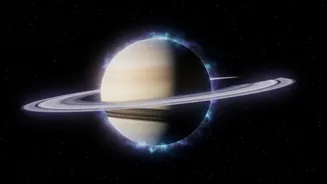
The new research reveals that Saturn’s magnetosphere is far from symmetrical. On Earth, the magnetosphere has openings near the poles, called cusps, where solar wind particles can enter. These cusps are typically located around noon, facing the Sun. The new analysis shows Saturn's cusps are consistently dragged far toward the afternoon or dusk side. Instead of being at the 12 o'clock position, they are often found between 1 and 3 o'clock, and sometimes even later. This confirms that giant, fast-spinning planets like Saturn operate under a different set of rules than rocky worlds like ours. The planet's own rapid rotation, not the solar wind, is the dominant force shaping its magnetic environment.
The Influence of Moons
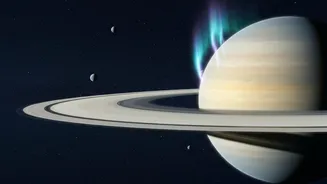
The cause of this lopsidedness isn't just Saturn's breakneck 10.7-hour day. The planet's moons, especially the geologically active Enceladus, play a crucial role. Enceladus constantly spews water ice and gas from plumes erupting from its subsurface ocean. This material becomes ionized, forming a heavy soup of plasma that Saturn’s magnetic field has to drag along as it rotates. This massive, rotating load of plasma, combined with the planet’s fast spin, effectively overpowers the influence of the Sun's solar wind and skews the entire magnetic structure. It’s this external interaction, rather than just the planet's deep interior, that creates the complex behavior scientists have observed for years.
Why This Discovery Matters
Solving the mystery of Saturn's skewed magnetosphere does more than just fill in a blank in our planetary science textbooks. It provides a new understanding of how magnetic fields function on gas giants, which is crucial for studying planets beyond our solar system. Knowing the true shape of Saturn’s magnetic shield helps scientists better map its auroras and understand where explosive energy releases occur. This breakthrough is a testament to the enduring legacy of the Cassini mission, demonstrating that the data from past explorations can continue to yield fundamental discoveries long after the spacecraft itself is gone. It underscores the incredible value of collecting detailed, long-term data in these alien environments.