

The Universe’s Biggest Mystery
For decades, scientists believed the expansion of the universe, which started with the Big Bang, should be slowing down due to gravity. However, observations in 1998 showed the exact opposite was happening; the expansion was speeding up. To explain this,
physicists proposed the existence of an invisible force or energy, which was dubbed 'dark energy'. It acts as a sort of anti-gravity, pushing everything apart. While ordinary matter and dark matter pull things together, dark energy dominates the cosmos, making up an estimated 68% of its total mass-energy content. Scientists aren't sure what it is—it could be an intrinsic property of space itself, known as the 'cosmological constant', or a new, evolving energy field. Whatever it is, understanding dark energy is crucial to understanding the ultimate fate of our universe.
Meet NASA’s New Cosmic Detective
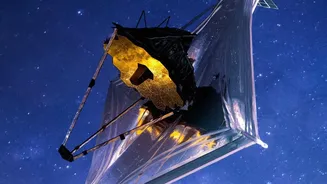
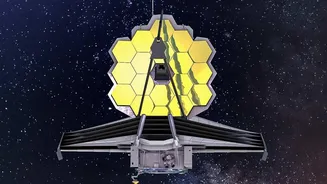
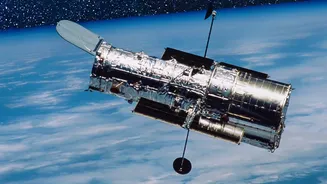
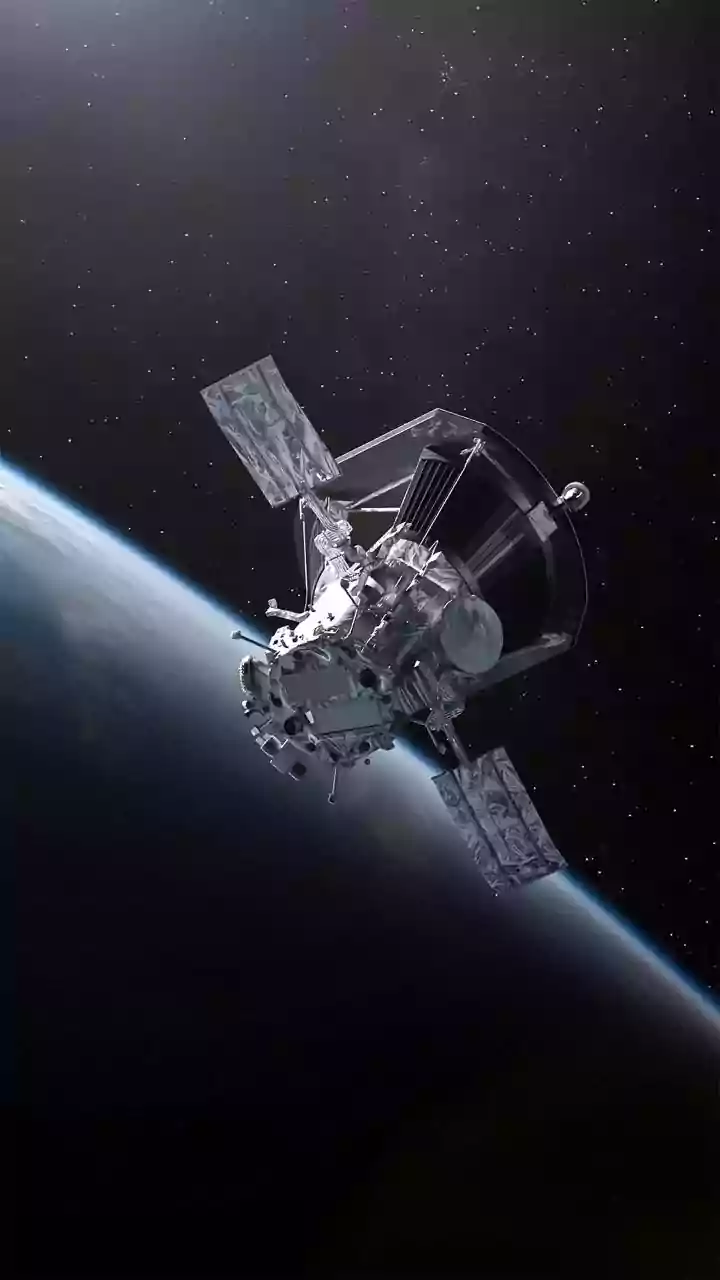
Enter the Nancy Grace Roman Space Telescope. Launched on August 30, 2026, this next-generation observatory is NASA's new flagship mission designed to unravel cosmic enigmas. Named after Nancy Grace Roman, NASA's first chief of astronomy, the telescope has a primary mirror that is 2.4 meters (7.9 feet) in diameter, the same size as the Hubble Space Telescope's. But its key advantage is its Wide Field Instrument, a 300-megapixel camera that gives it a field of view at least 100 times larger than Hubble's. This means Roman can create massive, high-resolution panoramas of the sky with incredible speed. What might take Hubble years to survey, Roman can accomplish in a matter of months, generating an unprecedented amount of data for scientists to analyse.
How to Hunt for the Unseen
You can't observe dark energy directly, but you can measure its effects on the universe. The Roman telescope will do this using three main techniques. First, it will hunt for thousands of Type Ia supernovae—exploding stars that always detonate with a similar intrinsic brightness. By comparing how bright they appear to us with how bright they 'should' be, scientists can calculate their distance with great precision. This helps map the expansion history of the universe. Second, Roman will study 'weak gravitational lensing', where the gravity of massive objects, like galaxies, bends and distorts the light from more distant objects behind them. Mapping these distortions reveals how matter is clustered throughout the cosmos, which is influenced by dark energy. Finally, the telescope will measure 'baryon acoustic oscillations', which are subtle, large-scale patterns in the distribution of galaxies that serve as a cosmic ruler to track expansion.
A Panoramic View of the Cosmos
Roman’s power lies not just in its precision, but in its scale. While Hubble provides stunningly deep, narrow 'zoom lens' views of the cosmos, Roman acts as the 'wide-angle lens'. Over its five-year primary mission, Roman will image more than 50 times the area of sky that Hubble has covered in its entire 30-plus years of operation. These vast surveys will create the largest 3D maps of the universe ever attempted. By observing billions of galaxies across cosmic time, the mission will track how dark energy's influence has changed over billions of years. These observations will provide the most precise measurements yet of the universe's evolution, allowing scientists to test fundamental theories of physics, including Einstein's theory of general relativity, on the grandest of scales.
Solving the 'Hubble Tension'
Beyond the primary quest to understand dark energy, Roman's data could help solve another pressing cosmic puzzle: the 'Hubble Tension'. Currently, there is a significant disagreement between the two main methods used to calculate how fast the universe is expanding today. Measurements from the early universe (the cosmic microwave background) give one number, while measurements using objects in the nearby universe (like supernovae) give another, faster rate. This discrepancy suggests there might be a flaw in our understanding of the universe—our 'standard model of cosmology'. Roman is designed to probe the universe with about ten times more precision than previous experiments, which could be enough to resolve this tension, either by finding a subtle error in our measurements or by pointing toward new, undiscovered physics.