





Recent updates to India's travel rules have created confusion about which identity documents are valid. While some rules have been relaxed, it’s a mistake to assume any government-issued ID will get you on a flight. Here's what you need to know.
The Golden Rule: Passport for International Travel
Let’s
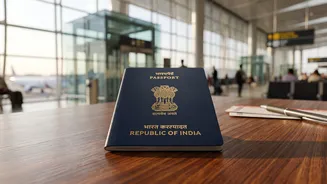
start with the clearest rule: for any international travel outside of a few specific exceptions, an Indian passport is the only acceptable travel document. Your Aadhaar card, PAN card, or driver's licence cannot be used to board a flight to the United States, the UK, the UAE, or any other country. These documents are designed for domestic identification within India's borders. Airlines and foreign immigration authorities will require a valid passport, and in most cases, a visa for entry. A recent amendment to immigration rules on November 5, 2026, reinforces that Indians travelling to a third country via Nepal or Bhutan must still carry a valid passport and use designated immigration checkpoints.
Domestic Flights: More Flexibility, But Rules Still Apply
For travel within India, the rules are much more flexible. Passengers are required to carry a valid, original government-issued photo ID. Accepted documents almost universally include an Aadhaar card (in physical or digital form like mAadhaar or from DigiLocker), a valid passport, a driver's licence, a Voter ID card, and a PAN card. Other accepted proofs can include a photo ID card issued by a central or state government employer, a student ID from a recognised institution, or even a nationalised bank passbook with an attested photograph. The key is that the ID must be an original (or approved digital version) and the name on it must exactly match the name on your flight ticket. Photocopies are generally not accepted.
The Nepal and Bhutan Exception: A Common Point of Confusion
Travel to neighbouring Nepal and Bhutan has special rules, which are a frequent source of misunderstanding. A Ministry of Home Affairs notification on November 5, 2026, clarified that Indian citizens can travel to these countries without a passport, but they must produce an identity document specified in the government's Visa Manual. For air travel to Nepal, the Embassy of India in Kathmandu is explicit: only a valid Indian passport or an original Voter ID card from the Election Commission of India are accepted. It specifically states that Aadhaar cards, PAN cards, and driver's licences are not valid for this purpose. For Bhutan, Indian nationals can use either a valid passport or a Voter ID card to obtain an entry permit.
Aadhaar's Role: Not a Universal Travel Pass
Despite being the world's largest biometric ID system, the Aadhaar card is not a replacement for a passport and has specific limitations for travel. Its primary purpose is to serve as a proof of identity and address within India. While it is widely accepted for domestic flights, its use for cross-border travel is very limited. One notable exception allows Indians under the age of 15 and over 65 to use their Aadhaar card as a valid travel document to enter Nepal and Bhutan. However, for citizens between these ages, an Aadhaar card is not sufficient for travel to Nepal or Bhutan; a passport or Voter ID is required.