




A Cosmic Backyard Laboratory
For decades, the Beta Pictoris system has been a go-to for astronomers wanting to watch a planetary system grow up. At only 23 million years old, it's a mere infant compared to our own 4.5-billion-year-old Solar System. This youth is crucial because it gives
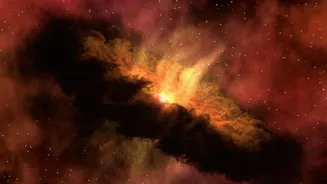
scientists a rare glimpse of planets interacting with the vast, dusty disk of gas and debris from which they were born. This disk, the first of its kind ever to be imaged around another star, is a messy, dynamic place, full of clues about planetary formation. Before the latest discovery, astronomers knew of two gas giant planets, Beta Pictoris b and Beta Pictoris c, orbiting the bright central star. Beta Pictoris b was one of the very first exoplanets ever to be directly photographed, making the system a cornerstone of exoplanet studies.
An Accidental Discovery
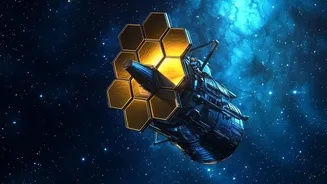
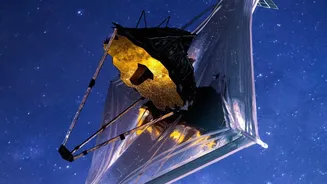
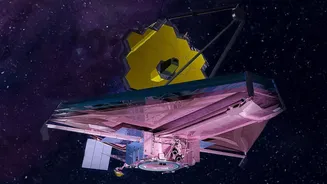
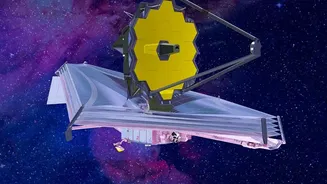
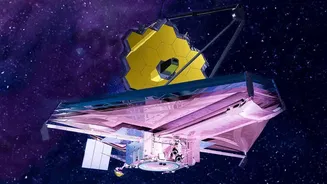
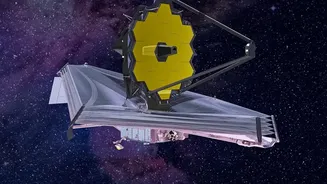
The latest discovery of a third planet, named Beta Pictoris d, was an accident. A team of astronomers was using the JWST's powerful Near-Infrared Spectrograph (NIRSpec) instrument to study the atmosphere of the already-known planet, Beta Pictoris b. They weren't looking for another world. But as they analysed the data, a faint, unexpected signal appeared. This wasn't the typical bright dot of light that signals a planet in a direct image. Instead, it was a unique chemical signature, the tell-tale pattern of gases absorbing light in a planetary atmosphere. This spectral fingerprint, which revealed traces of methane, carbon monoxide, and water, confirmed they had found a new world. This makes Beta Pictoris only the second system known to contain at least three directly imaged planets.
A New Way to Find Planets
Finding Beta Pictoris d wasn't just exciting; it was revolutionary. The planet had remained hidden because it was lost in the glare of the system's massive, foggy debris disk. Conventional imaging techniques struggle to separate the faint light of a planet from the bright, scattered light of such a disk. But Webb’s spectroscopic method effectively sidestepped this problem. By breaking the light from the system into a spectrum—like a rainbow—astronomers could isolate the specific molecular signatures unique to a planet's atmosphere. This technique of finding a planet by its chemical makeup, rather than its brightness, opens a new door for discovering worlds in complex, dusty environments where they might otherwise be missed. It proves that astronomers can hunt for planets by looking for their atmospheric fingerprints, a game-changer for the field.
The System's New Architect
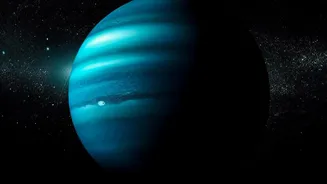
The new planet is a gas giant estimated to be at least two times the mass of Jupiter, making it the smallest of the three known worlds in the system. It orbits its star at a distance comparable to Neptune's in our solar system, placing it on the widest orbit of the trio but still inside the main debris disk. For years, scientific models of Beta Pictoris suggested something was missing. There were hints that an unseen planet was gravitationally sculpting the inner edge of the debris disk, but the two known planets couldn't account for it. The discovery of Beta Pictoris d, right where theorists predicted a planet might be, appears to solve this long-standing puzzle. This hidden world is likely the architect responsible for shaping the structure of its cosmic home.