



A New Cosmic Surveyor Takes Flight
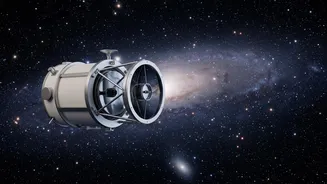
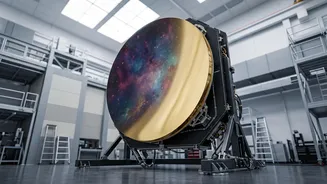
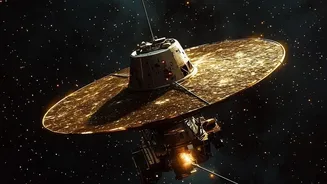
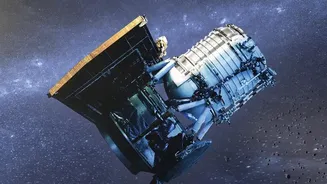
Named after Nancy Grace Roman, NASA's first chief of astronomy and the visionary 'mother of Hubble,' the Roman Space Telescope is the agency's latest flagship mission. Launched in late August 2026, the observatory is now journeying to its operational
orbit about 1.5 million kilometers from Earth. While its 2.4-meter primary mirror is the same size as the one on the Hubble Space Telescope, Roman is a completely different kind of instrument. It’s not designed to be a zoom lens for studying individual objects in extreme detail, but rather a powerful survey machine built to create vast, panoramic maps of the sky in infrared light. Its primary purpose is to tackle some of the biggest questions in cosmology by observing the universe on an unprecedented scale.
The Power of a Panoramic View
The defining feature of the Roman Telescope is its Wide Field Instrument (WFI), a 300-megapixel camera that gives it an enormous field of view. To put it in perspective, this eye on the cosmos can see an area of the sky at least 100 times larger than Hubble's primary infrared camera in a single snapshot, all while maintaining a similar sharpness and resolution. Where Hubble would need hundreds of individual images stitched together over weeks to map a small patch of a neighboring galaxy, Roman can capture it in just a couple of pointings. This incredible survey speed—estimated to be about 1,000 times faster than Hubble's—will allow Roman to map huge portions of the universe, creating a treasure trove of data that will keep astronomers busy for decades. In its first five years, Roman is expected to image 50 times more sky than Hubble has in over 30 years of operation.
Hunting for Dark Energy's Secrets
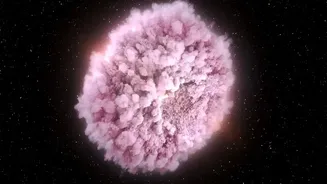
One of Roman's key missions is to investigate the nature of dark energy, the mysterious force causing the expansion of the universe to accelerate. Scientists still don't fully understand what dark energy is, but Roman will attack the problem from multiple angles. It will conduct massive surveys to map the positions of billions of galaxies, studying how their distribution has been shaped by cosmic expansion over time. It will also hunt for thousands of distant supernovae, a type of stellar explosion that serves as a 'standard candle' for measuring cosmic distances. By precisely measuring their brightness and distance, astronomers can chart the expansion history of the universe and learn more about the properties of the dark energy driving it.
A Census of a Billion Stars
Beyond cosmology, Roman is poised to revolutionize the search for exoplanets. The telescope will conduct a massive survey of the Milky Way's central bulge, monitoring hundreds of millions of stars for tiny changes in their brightness. This will allow it to detect thousands of new worlds using two main methods. The first is gravitational microlensing, where the gravity of a foreground planet and its star briefly magnifies the light from a more distant star, revealing the planet's presence. This technique is sensitive enough to find planets down to the mass of Mars and even free-floating 'rogue planets' not bound to any star. The second method is the transit technique, which will spot the slight dimming of starlight as a planet passes in front of its host star. Together, these surveys are expected to discover over 100,000 new exoplanets, vastly expanding our catalogue of known worlds.
A Partner to Hubble and Webb
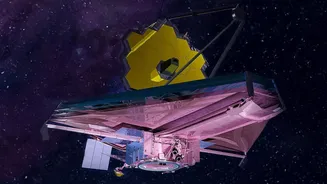
Roman isn't a replacement for telescopes like Hubble or the James Webb Space Telescope (JWST), but a powerful complement. While Roman rapidly scans vast areas of the sky to find interesting targets, Hubble and Webb can then perform detailed, focused observations on those objects. For instance, Roman's survey may uncover thousands of fascinating galaxies or planetary systems, creating a catalogue for Webb to investigate further with its powerful spectroscopic tools. Additionally, Roman carries a technology demonstrator called the Coronagraph Instrument, designed to block the overwhelming glare of a star to directly image the faint planets orbiting it. This will pave the way for future missions aimed at finding and characterizing Earth-like worlds around other stars.