




The Heavy Element Problem
For much of history, we have known that stars are the universe's element factories. Through nuclear fusion, stars spend their lives crushing lighter elements into heavier ones, a process that powers them and creates essentials like carbon and oxygen.
This process works well up to iron. Beyond that, creating heavier elements like gold, uranium, and platinum requires more energy than it releases. Normal stellar fusion simply cannot do the job. For decades, this left a significant gap in our understanding: if not in stars, where did half of the elements heavier than iron come from?
Cosmic Ghosts: What Are Neutron Stars?
Enter the neutron star. When a massive star runs out of fuel, it collapses under its own gravity and explodes in a supernova. What's left behind is an incredibly dense core. Imagine the mass of our sun squeezed into a ball just a few kilometers wide. These objects, called neutron stars, are so dense that a single teaspoon of their material would weigh billions of tons. They are composed almost entirely of neutrons packed tightly together. While fascinating on their own, it's what happens when two of these stellar remnants get close that solves the heavy element mystery.
A Violent Cosmic Dance
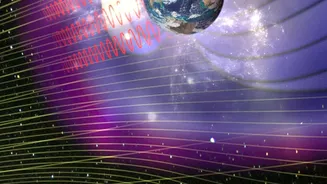
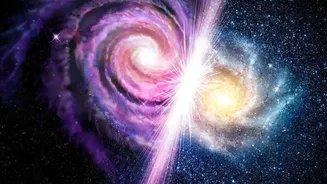
When two neutron stars orbit each other in a binary system, they slowly spiral inward, losing energy by creating ripples in spacetime known as gravitational waves. This cosmic dance can take millions of years, but it ends in a cataclysmic collision. In the final moments, the two stars, each moving at a fraction of the speed of light, crash and merge. The event unleashes an almost unimaginable amount of energy and unleashes a torrent of free neutrons, creating the perfect conditions for building the universe's heaviest elements.
The 'r-Process' Forges Treasure
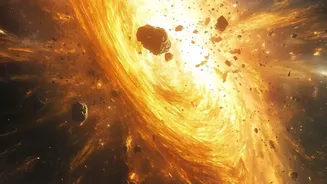
This chaotic environment is the site of what scientists call the rapid neutron-capture process, or 'r-process'. In the seconds following the merger, atomic nuclei are bombarded with an incredibly dense flood of neutrons. The nuclei capture these neutrons one after another, far faster than they can radioactively decay. This rapid absorption inflates the atomic nuclei, which then undergo decay to become stable, heavy elements like platinum, gold, and uranium. The collision essentially serves as a high-speed cosmic forge, creating hundreds of Earth masses' worth of precious metals in a single event.
The Golden Observation of 2017
This theory remained just that—a compelling theory—until August 17, 2017. On that day, observatories on Earth detected gravitational waves from an event 130 million light-years away, named GW170817. Seconds later, space telescopes detected a burst of gamma rays from the same patch of sky. Telescopes around the world quickly turned to the source and witnessed the glowing aftermath of a neutron star merger for the first time. This explosion, dubbed a kilonova, provided direct evidence. As they studied the light from the expanding cloud of debris, astronomers detected the distinct signatures of freshly synthesized heavy elements, including gold and platinum. It was the first time scientists had witnessed the r-process in action, confirming that these mergers are a primary source of the universe's heavy treasures.