

A Celestial Lion's Roar
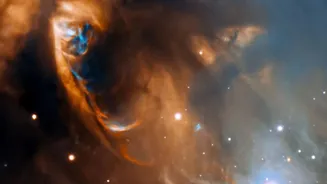
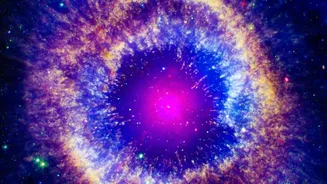
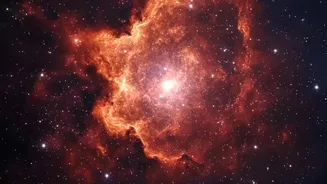
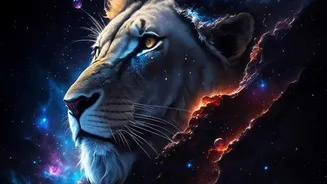
The latest subject of Webb’s powerful gaze is NGC 2392, a planetary nebula nicknamed the Lion Nebula for its remarkable resemblance to a lion's head, complete with a flowing mane. At its heart, a tiny but intensely hot star, known as a white dwarf, looks
like the button nose of the cosmic feline. This central star is the engine driving the entire spectacle. It is blasting radiation into clouds of gas and dust that it shed thousands of years ago, carving out the nebula’s distinct shape. The new composite image, combining data from two of Webb's key instruments, shows this dramatic scene with a clarity that surpasses even previous views from the Hubble Space Telescope. The 'face' of the lion is a bubble of superheated gas, while the 'mane' consists of a sprawling shell of dust and surviving material, creating a portrait of beautiful destruction.
The Story of a Dying Star
Despite its name, a planetary nebula has nothing to do with planets. It is the final, fleeting stage in the life of a star similar to our own Sun. When such a star runs out of fuel for nuclear fusion in its core, it becomes unstable and ejects its outer layers into space. The remaining core collapses into a dense, hot white dwarf. The intense ultraviolet radiation from this stellar remnant then causes the expelled gas to glow, creating the intricate and colorful structures that astronomers can observe. The Lion Nebula is a snapshot of this process, which has been evolving for several thousand years. In astronomical terms, it's a short-lived phenomenon; scientists estimate that NGC 2392 will completely disperse in about 10,000 years, its materials recycling back into the cosmos.
Two Views Are Better Than One
The stunning detail in the new image is possible because Webb observed the nebula using two different infrared instruments, each telling a different part of the story. The Near-Infrared Camera (NIRCam) captures shorter infrared wavelengths, providing a high-resolution look at the hotter gas structures and stars. In this view, the cavernous shells and expanding bubble of ionized gas that form the lion’s 'face' are sharply defined. In contrast, the Mid-Infrared Instrument (MIRI) is sensitive to longer infrared wavelengths, which are ideal for detecting cooler dust. MIRI’s view highlights the dusty 'mane,' revealing how some clumps of dust manage to survive the central star’s fierce radiation while others are destroyed. By combining these two views, astronomers get a more complete picture of the interplay between gas and dust in this dynamic environment.
Unlocking Cosmic Secrets
This detailed look at the Lion Nebula is more than just a pretty picture; it provides valuable scientific insight. The comet-like tails seen in the mane are actually dense clumps of dust that have so far withstood the onslaught of radiation from the central star. These clumps act like shields, protecting the material located behind them. Studying these surviving structures helps scientists understand how gas and dust behave in the harsh environment around a dying star. It is a key part of understanding the life cycle of stars and how they enrich the galaxy with heavier elements and complex materials that will eventually form new stars and planets. Each feature, from the glowing gas to the dusty filaments, offers clues about the physical processes shaping the universe on a grand scale. Webb’s ability to freeze this moment in time allows for an unprecedented study of a star's final act.