



A Portrait of a Distant World
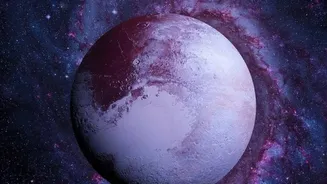
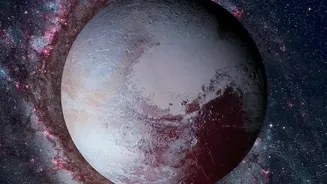
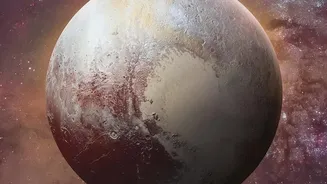
When NASA's New Horizons spacecraft flew past Pluto in 2015, it transformed our view of this distant body from a fuzzy pixel into a vibrant, active world. The images sent back showed towering mountains made of water ice as hard as rock, vast plains of frozen
nitrogen, and a giant, heart-shaped glacier named Sputnik Planitia. But alongside these grand features were more subtle mysteries: dark, reddish-brown streaks and patches staining the otherwise bright, icy landscape, particularly around the northern edges of the 'heart'. These markings hinted that Pluto was far from a simple, static ball of ice and rock.
The Prime Suspect: Tholins
For decades, scientists have known that Pluto has a reddish hue. The prevailing theory is that this colour comes from complex organic molecules called 'tholins'. Tholins are created when ultraviolet light from the sun, or cosmic rays, interacts with simple molecules like methane and nitrogen, which are present in Pluto’s thin atmosphere and on its surface. This radiation breaks the molecules apart, and they then re-form into larger, more complex, and darker compounds. This 'gunk', as some scientists describe it, then settles onto the surface, creating a reddish-brown veneer. This process is believed to be responsible for the dark colours seen not only on Pluto but also on other distant bodies, including its largest moon, Charon.
A World That Is Surprisingly Active
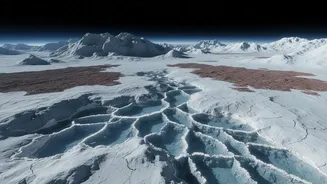
While tholins explain the colour, they don’t fully explain the specific patterns of lines and patches. Recent analysis of the New Horizons data, published in 2026, has provided a compelling and surprising explanation: liquid nitrogen may be flowing up from beneath the surface. Researchers noticed that the dark features on Sputnik Planitia look very similar to wetted areas on glaciers here on Earth. Given Pluto’s extreme cold and thin atmosphere, liquid nitrogen rain is impossible. Instead, scientists propose that pressure deep beneath the multi-kilometre-thick nitrogen glacier could be sufficient to melt the nitrogen at its base. This liquid, being buoyant, could then be forced up through cracks in the ice.
Painting the Surface from Below
Once this liquid nitrogen reaches the surface, it would temporarily 'wet' the frozen nitrogen ice before refreezing. This process could darken the surface in two ways: by making the ice grains larger, which makes them less reflective, or by concentrating the dark tholin residues that were already mixed in with the ice. This suggests a dynamic cycle of subsurface melting and surface expression, more like a geological process than a simple atmospheric deposit. According to Alan Stern, the principal investigator for the New Horizons mission, these findings suggest that Pluto has a new kind of time-variable feature and that liquids have recently expressed themselves on its surface.
What This Means for Pluto's Story
The evidence of recent liquid flow fundamentally changes our understanding of Pluto. It implies that the dwarf planet is geologically active, with enough internal heat to create liquid deep beneath its icy shell. This activity might come in periodic bursts, with liquid nitrogen building up in underground reservoirs before erupting onto the surface. These processes are actively reshaping Pluto’s landscape, painting it with dark streaks that tell a story of a complex inner life. Far from being a dead world at the edge of our solar system, Pluto continues to reveal itself as a place of ongoing geological drama, with secrets still hidden beneath its famous frozen heart.